
Fajr prayer is the dawn prayer, the first of the five daily prayers, and the shortest of them: 2 obligatory rak’ahs, prayed between true dawn and sunrise. This guide gives you the exact time window for Fajr prayer, the 4 rak’ahs in order, the words and movements step by step, and a 7-day plan to pray Fajr on time every morning. If you cannot read Arabic yet, start with Noorani Qaida at the same time — your teacher teaches the letters while you learn the Fajr words line by line.
The Quran names the dawn prayer directly: “Observe the prayer from the decline of the sun until the darkness of the night and the dawn prayer, for certainly the dawn prayer is witnessed.” (Quran 17:78) The Prophet (peace be upon him) said, “The two rak’ahs at dawn are better than this world and what it contains.” (Sahih Muslim 725a) Fajr prayer is the first prayer of the day, and the one most beginners learn first, because it teaches the full shape of a prayer in the fewest steps. See the full five-prayer guide for how Fajr fits into the day.
Before You Start: What You Need for Fajr Prayer
You need 4 things before your first Fajr prayer: wudu, the qibla direction, the Fajr prayer time for tomorrow, and the words of Surah Al-Fatiha. Wudu is the washing done before prayer. If you slept after Isha, you need fresh wudu. The qibla is the direction of the Ka’bah in Mecca; your prayer app or your teacher can show you the direction from your home. Check tomorrow’s Fajr time tonight, before bed, and set your alarm for it. That one step decides whether you pray Fajr on time or sleep through it.
You do not need to know Arabic to start. Learn Surah Al-Fatiha line by line from transliteration while you study Qaida. Your teacher checks your pronunciation each week, so errors get fixed in the first week instead of becoming habits. A prayer mat, a quiet corner, and a phone alarm are the only equipment. The whole prayer takes about 10 minutes: 2 to 3 minutes for wudu, 2 minutes for the 2 sunnah rak’ahs, and 4 to 5 minutes for the 2 fard rak’ahs.
When Is Fajr Prayer? True Dawn to Sunrise, About 60 to 90 Minutes
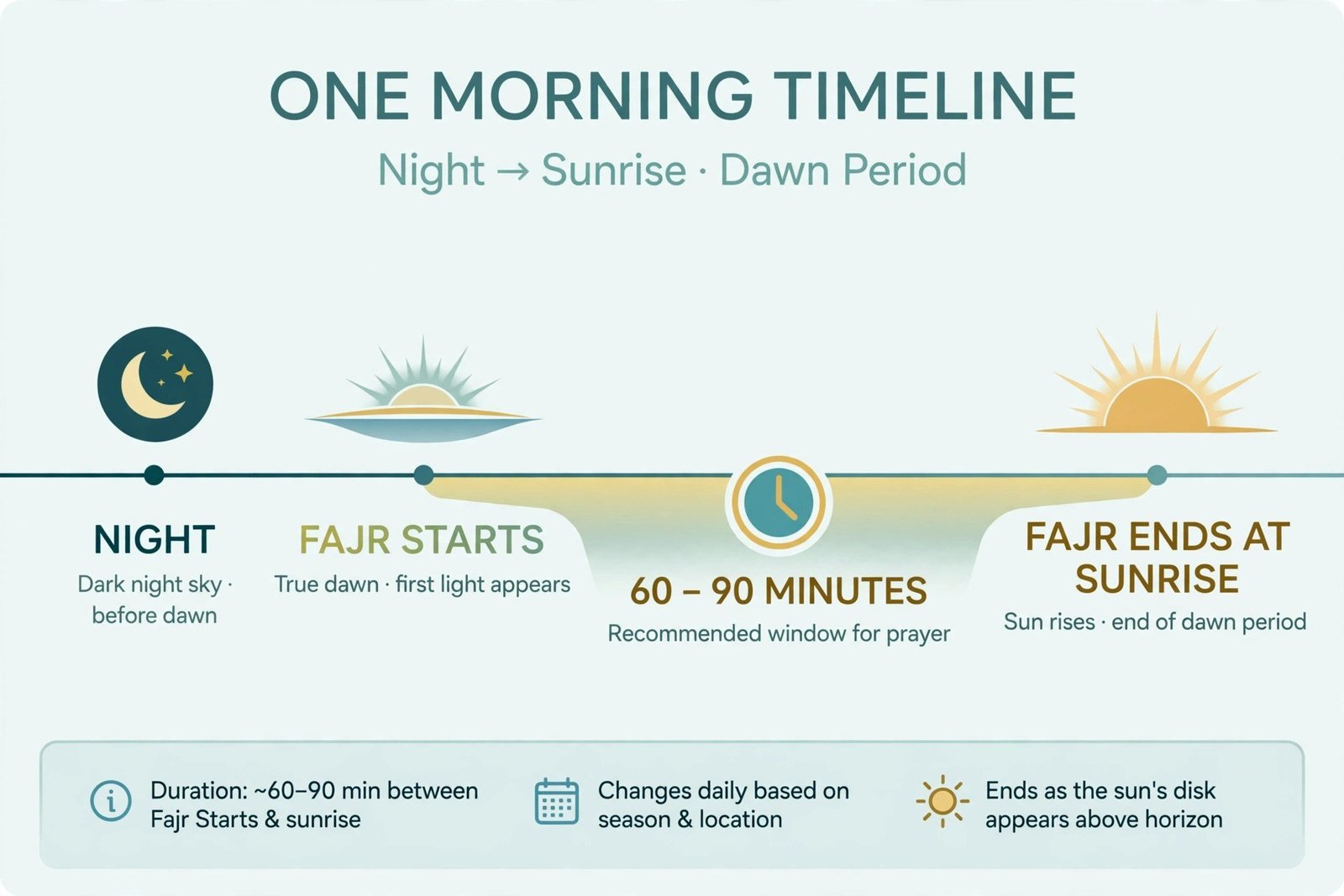
Fajr prayer begins at true dawn, when the first horizontal light spreads across the horizon, and ends at sunrise, when the top of the sun appears. That window is about 60 to 90 minutes long in most places, depending on your location and the season. Once the sun starts to rise, Fajr prayer time is over, and the prayer is prayed as a make-up rather than on time.
| Season example | Dawn (Fajr starts) | Sunrise (Fajr ends) | Window length |
|---|---|---|---|
| Winter morning | 5:45 AM | 7:00 AM | 75 minutes |
| Spring morning | 5:00 AM | 6:15 AM | 75 minutes |
| Summer morning | 4:00 AM | 5:30 AM | 90 minutes |
| Autumn morning | 5:30 AM | 6:45 AM | 75 minutes |
These are worked examples with stated clock times, not your city’s times. Your city’s times shift a few minutes every day, so check your local mosque timetable or a prayer-time app each evening. The window is shortest in winter in some places and longest in summer, but it never drops below about 60 minutes. That is enough time for wudu, the 2 sunnah rak’ahs, and the 2 fard rak’ahs, with time to spare. Set the alarm for 15 minutes before the start of Fajr, not for the start itself, so you have time to wake up, make wudu, and pray without rushing.
How Many Rak’ahs Is Fajr Prayer? 2 Sunnah, Then 2 Fard
Fajr prayer has 4 rak’ahs in total: 2 sunnah rak’ahs prayed first, then 2 fard rak’ahs. Only the 2 fard rak’ahs are obligatory. The 2 sunnah rak’ahs are strongly emphasized and the Prophet (peace be upon him) rarely missed them, so pray all 4 when you can. If you wake up late and only have time for one set before sunrise, pray the 2 fard rak’ahs first.
| Part | Rak’ahs | Ruling | Recitation |
|---|---|---|---|
| Sunnah before Fajr | 2 | Strongly emphasized | Aloud, short surahs |
| Fard (obligatory) | 2 | Required | Aloud, longer recitation |
| Total | 4 | — | — |
Fajr prayer is recited aloud, unlike Dhuhr and Asr, which are silent. Praying alone, say the words audibly but softly. In congregation, the imam recites aloud and the followers listen. There are no sunnah rak’ahs after Fajr, and voluntary prayer is not allowed once the sun has risen until it is fully up. The sunnah recitation is short: the Prophet (peace be upon him) often recited Surah Al-Kafirun in the first sunnah rak’ah and Surah Al-Ikhlas in the second. The fard recitation is longer, and the imam in congregation often recites from the longer surahs.
How to Pray Fajr Prayer, Step by Step: 7 Steps in 10 Minutes
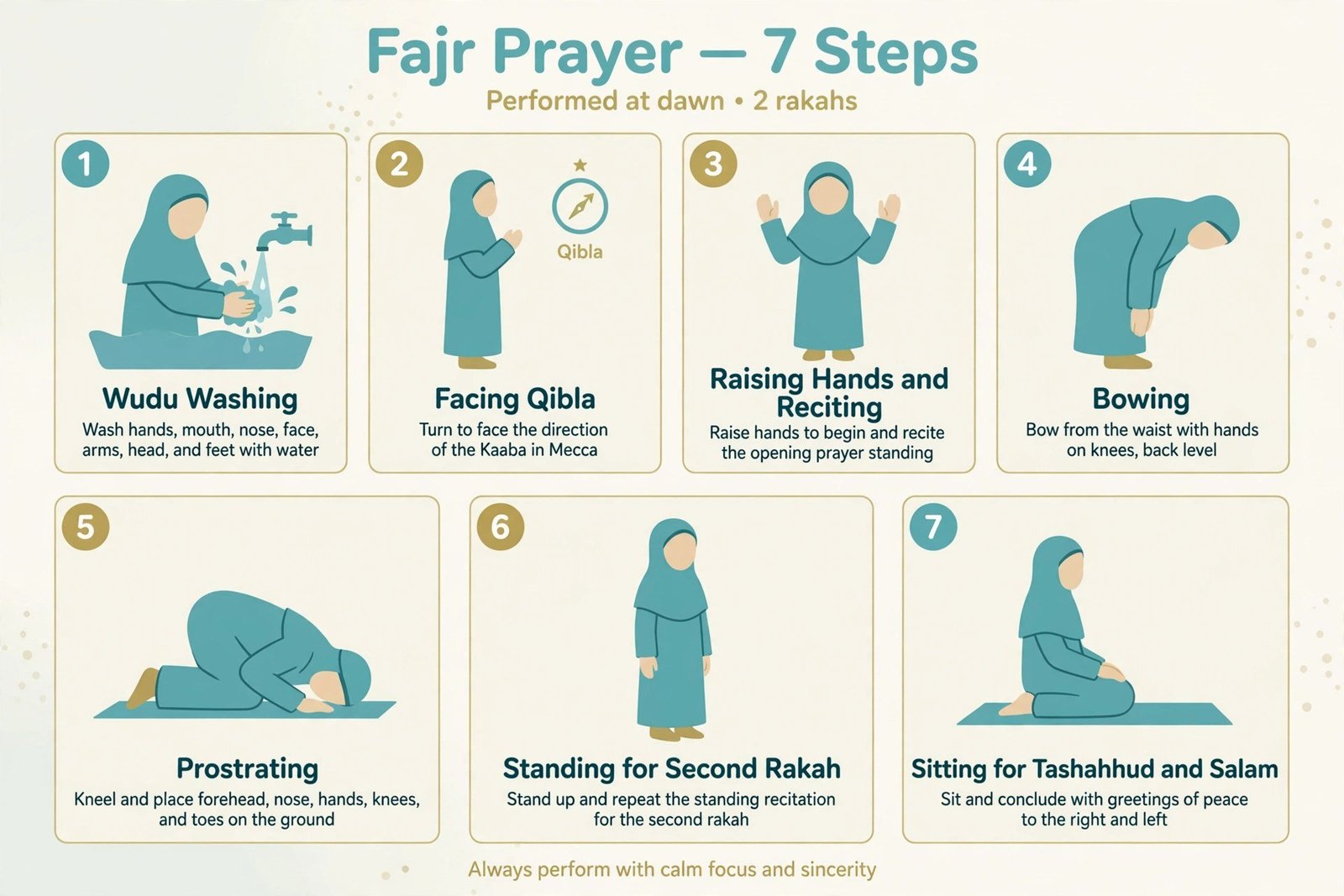
Follow these 7 steps for the 2 fard rak’ahs of Fajr prayer. The 2 sunnah rak’ahs follow the same steps, with shorter recitation.
The 7 Steps of Fajr Prayer in Order
- Make wudu. Wash in the prescribed order: hands, mouth, nose, face, arms to the elbows, head, ears, and feet to the ankles. Time: 2 to 3 minutes. Check: you are clean and ready before you stand on the mat.
- Face the qibla and make your intention. Stand facing the direction of the Ka’bah. Form the intention in your heart to pray the 2 fard rak’ahs of Fajr. Time: a few seconds. Check: you know which prayer you are praying before you begin.
- Say Allahu Akbar and recite Al-Fatiha aloud. Raise your hands to your shoulders or ears and say “Allahu Akbar” (Allah is the Greatest). Place your right hand over your left. Recite Surah Al-Fatiha aloud, then another surah or some verses. Time: 1 to 2 minutes per rak’ah. Check: you can hear your own recitation.
Steps 4 to 7: Bow, Prostrate, and End with Salam
- Bow (ruku). Say “Allahu Akbar” and bow with a flat back and hands on your knees. Say “Subhana Rabbiyal Azim” (Glory is to my Lord, the Most Great) 3 times. Time: 20 to 30 seconds. Check: your back is straight and still before you rise.
- Rise, then prostrate twice (sujud). Stand upright, then say “Allahu Akbar” and go down with forehead, nose, palms, knees, and toes on the ground. Say “Subhana Rabbiyal A’la” (Glory is to my Lord, the Most High) 3 times in each prostration, sitting briefly between the two. Time: about 1 minute. Check: you pause in each position until you are still.
- Stand for the second rak’ah. Rise saying “Allahu Akbar” and repeat the recitation, bowing, and two prostrations. Time: 2 to 3 minutes. Check: the second rak’ah matches the first in order.
- Sit for the tashahhud and end with salam. After the second prostration of the second rak’ah, sit and say the tashahhud, then the blessings on the Prophet (peace be upon him). Turn your head right and say “Assalamu alaikum wa rahmatullah”, then left and say the same. Time: about 1 minute. Check: you have said the salam to both sides before you move.
That is the full fard prayer. Pray the 2 sunnah rak’ahs first, in the same 7 steps with shorter recitation, and the whole Fajr prayer takes about 10 minutes. If you are learning, your teacher walks you through these steps in class and checks each one. Learn how long Noorani Qaida takes if you are starting from the alphabet.
Mosque, Home, or Make-Up: Which Fajr Prayer Applies to You?
Use this decision tree to pick the right Fajr for your morning.
You wake up before Fajr and live near a mosque? Pray at the mosque. Congregation carries its own reward, and the walk there wakes you up fully. Leave home 10 minutes before Fajr starts.
You wake up before Fajr and cannot reach a mosque? Pray at home. Pray the 2 sunnah rak’ahs first, then the 2 fard rak’ahs, in the same order. Praying at home on time beats praying at the mosque late.
You wake up after sunrise? Pray Fajr as soon as you wake. Pray the 2 fard rak’ahs first, then the 2 sunnah rak’ahs if time allows. Anyone who sleeps through Fajr prays it as soon as they wake. Do not skip it because the window passed.
You are teaching a child? Wake the child 10 minutes before Fajr on weekends first, when there is no school rush. One Fajr a week, prayed with a parent, builds the habit faster than a rushed weekday attempt. Read the guide on the best age to start Quran classes for the right starting age.
Your First Week of Fajr Prayer: A 7-Day Plan That Works
Say you are an adult beginner who cannot read Arabic yet. You book 3 classes a week, 30 minutes each, and you practice 10 minutes a day at home. Here is what the first 7 days look like.
Day 1: check tomorrow’s Fajr time before bed and set 2 alarms, one for 15 minutes before Fajr and one at Fajr time. Put the phone across the room so you have to stand up to silence it. In class, your teacher teaches the first 2 lines of Al-Fatiha.
Day 2: pray the 2 fard rak’ahs only, reading Al-Fatiha from a transliteration card. Do not worry about the sunnah rak’ahs yet. Two rak’ahs done on time beats 4 rak’ahs skipped.
Day 3: add the 2 sunnah rak’ahs before the fard. The sunnah recitation is short, so the whole prayer is still under 10 minutes. Your teacher checks your Al-Fatiha in class.
Days 4 to 7: Make Fajr Prayer a Routine
Day 4: pray Fajr prayer at the mosque if you can, or at home with the family. Stay 5 minutes after the prayer for the morning remembrance. This is the day the habit starts to feel like a routine instead of an effort.
Day 5: learn the next 2 lines of Al-Fatiha in class and practice them at home for 10 minutes. You now know about half of the chapter from memory.
Day 6: pray all 4 rak’ahs from memory as far as you can, and use the card only for the lines you have not learned yet. Mark each day you pray Fajr on time in a notebook.
Day 7: pray the full Fajr on time for the 7th day in a row. Count your week: 7 out of 7 is a full week. 5 or more is a strong week. Below 4, keep the same plan for one more week instead of adding anything new.
That is 3 classes and about 70 minutes of home practice across the week. Most adult beginners need 2 to 4 weeks at this pace before Fajr feels steady, because Al-Fatiha takes longer for some people than for others. The plan above is a worked example with stated assumptions, not a promise.
What It Costs to Learn Fajr Prayer With a Teacher
Online Quran classes run $43 to $100 a month. Here is what each plan works out to per lesson.
| Plan | Price per month | Classes per week | Lessons per month | Cost per lesson |
|---|---|---|---|---|
| Starter | $43 | 2 | 8 | $5.38 |
| Standard | $55 | 3 | 12 | $4.58 |
| Intensive | $75 | 4 | 16 | $4.69 |
| Family | $100 | 5 shared | about 20 shared | $5.00 shared |
Cost per lesson is the monthly price divided by the lessons in the plan. The Standard plan gives the lowest cost per lesson at $4.58, and it is the plan most families pick for steady progress. Every plan includes a free trial class, and no card is required to book it. The Family plan shares 5 classes a week across 2 to 3 students, with a separate teacher for each child. One month of the Standard plan is 12 lessons, which is enough to learn Fajr and the first half of Al-Fatiha at the pace in the 7-day plan above.
What 5 Mistakes Cost You Fajr Prayer?
1. Setting one alarm at Fajr time. One alarm is easy to silence in your sleep. The cost: you wake at sunrise and Fajr is already over. Set 2 alarms, 15 minutes apart, and put the phone across the room.
2. Praying Fajr without checking the time the night before. Dawn moves a few minutes every day, so yesterday’s time is wrong today. The cost: you wake up and the window has already closed. Check tomorrow’s Fajr time before bed, every night.
3. Trying to learn all of Al-Fatiha before praying. Some beginners delay Fajr for weeks while they memorize the chapter. The cost: weeks with no Fajr habit at all. Pray from a transliteration card while you learn the lines one by one. The two tracks run together.
4. Skipping the 2 sunnah rak’ahs every day. The sunnah takes 2 minutes and the Prophet (peace be upon him) rarely missed it. The cost: you lose the reward of the 2 rak’ahs the hadith calls better than the world and what it contains. Pray them first, then the fard.
5. Staying up late after Isha. Fajr is a morning prayer, so the night before decides it. The cost: a 1 AM bedtime makes a 5 AM Fajr nearly impossible, and the habit breaks in the first week. Close the evening early after Isha and let the night wind down instead of opening the screen again.
Your Night-Before Fajr Prayer Checklist
Tick each item before bed. Five ticks means tomorrow’s Fajr is set up.
- Tomorrow’s Fajr time checked [ ]
- 2 alarms set, 15 minutes apart [ ]
- Phone across the room, not by the bed [ ]
- Wudu area and prayer mat ready [ ]
- Al-Fatiha transliteration card by the mat [ ]
- Intention made to wake for Fajr [ ]
How Much Time Does Fajr Take Each Day?
Fajr prayer takes about 10 minutes a day once you know the words: 2 to 3 minutes for wudu, 2 minutes for the 2 sunnah rak’ahs, and 4 to 5 minutes for the 2 fard rak’ahs. Add 5 minutes of morning remembrance after the prayer and the total is 15 minutes. That is the whole daily cost of the habit.
Learning time is separate. During the first month, plan for 30 minutes of class 3 times a week plus 10 minutes of practice a day: 160 minutes a week. After the first month, the class time drops away and only the 10 minutes of daily Fajr stays. Over a year, Fajr takes about 60 hours of prayer time and builds a habit that anchors the whole day.
Frequently Asked Questions
What time is Fajr prayer?
Fajr prayer starts at true dawn, when the first light spreads across the horizon, and ends at sunrise. The window is about 60 to 90 minutes. Check your local mosque timetable or a prayer-time app for your city’s exact times.
How many rak’ahs is Fajr prayer?
Fajr prayer is 2 fard rak’ahs, with 2 sunnah rak’ahs prayed before them, making 4 in total. Only the 2 fard rak’ahs are obligatory. If you wake up late, pray the fard first.
Is Fajr recited aloud or silently?
Fajr prayer is recited aloud. Praying alone, say the words audibly but softly. In congregation, the imam recites aloud and the followers listen. Dhuhr and Asr are the silent prayers.
What if I miss Fajr and wake up after sunrise?
Pray it as soon as you wake. Pray the 2 fard rak’ahs first, then the 2 sunnah rak’ahs if time allows. Do not skip it because the window passed.
Can I pray Fajr at home instead of the mosque?
Yes. Praying Fajr at home on time is valid and complete. Pray at the mosque when you can, and at home when you cannot reach one. The order is the same: 2 sunnah, then 2 fard.
What should I recite in Fajr?
Recite Surah Al-Fatiha in every rak’ah, followed by another surah or some verses. In the sunnah rak’ahs, the Prophet (peace be upon him) often recited Surah Al-Kafirun first and Surah Al-Ikhlas second. In the fard, the recitation is longer.
How long does it take to learn Fajr prayer?
Most adult beginners need 2 to 4 weeks at 3 classes a week with 10 minutes of daily practice. If you already read Arabic, the same plan often takes 1 to 2 weeks.
Book a Free Trial Class
Try one free 30-minute class with a certified male or female teacher, no card required. Your teacher will check your level and set a plan for Fajr and the other prayers. Book your free trial class.
Related Guides: Five Daily Prayers in Islam — What Time Is Asr? — How Long Does It Take to Learn Noorani Qaida? — How to Learn Quran Online — Best Age for Kids to Start Quran