Your child is 7 and cannot read Arabic yet. Start with Noorani Qaida, 3 classes a week, 30 minutes each. Most children finish in 4 to 6 months at that pace, and the first 4 weeks, the cost, and how to book a free trial are all below.
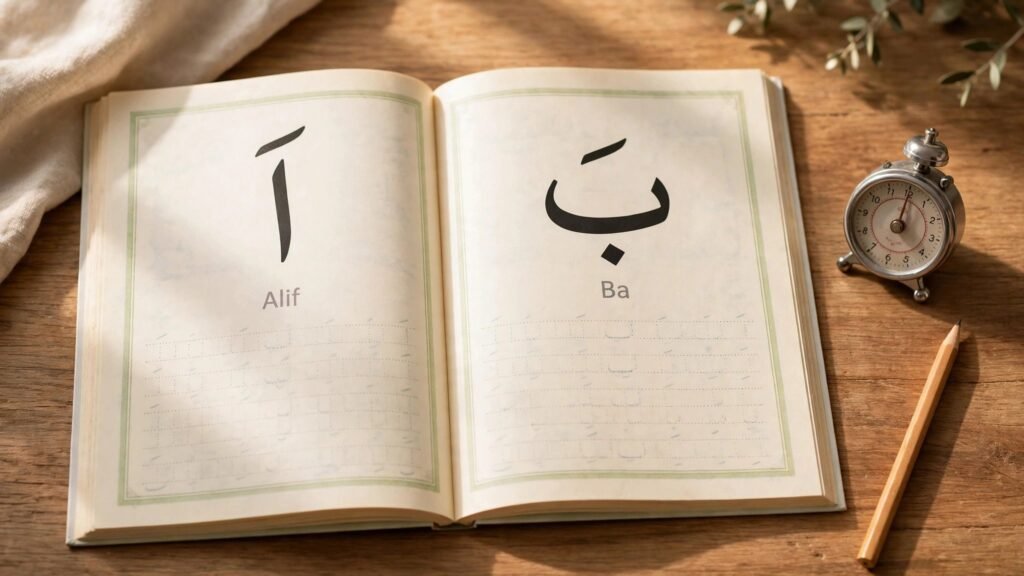
Noorani Qaida is the first book most Quran teachers use. It teaches the 28 Arabic letters, their sounds, how letters join, short vowels, long vowels, sukoon, and shaddah, one small step at a time. A child who finishes it can open the Quran and read words slowly and correctly. That is the whole point of the book, and it is why the Noorani Qaida course starts there for children from age 4 and for adults starting from zero.
Where to Start: Noorani Qaida First, Unless Your Child Can Already Read
Start with Qaida if your child cannot name the Arabic letters yet. That is the most common starting point, and it is the right one.
- Your child cannot read Arabic letters yet, or mixes up most of them. Start with the Noorani Qaida course. It is built for absolute beginners, ages 4 and up.
- Your child knows the letters but mispronounces several of them, especially the throat letters ha, ayn, and qaf. Start with Qaida too, and ask for a level check in the free trial. The teacher finds the first weak lesson and starts there instead of page 1.
- Your child reads words slowly but gets most letters right. Skip Qaida and go to the Quran Reading course. That course builds fluency with weekly reading targets.
- Your child reads fluently and wants the rules named and drilled. Go to the Quran with Tajweed course.
- You are an adult or a revert starting from the alphabet. Start with Qaida. Adult classes move faster and skip the children’s activities.
- Your daughter or you would prefer a female teacher. Say so when you book the free trial. The institute matches students with a male or female teacher by choice.
What Your Child Will Learn First: The 4 Stages of the Qaida Course
The Qaida course on this site has 4 stages. Each stage has one job, and a student moves on only when the teacher is satisfied with the reading.
Stage 1 covers the Arabic letters. Your child learns each letter on its own, its sound, and where the sound comes from in the mouth. The 28 letters include sounds English does not have, so this stage needs a teacher who hears every letter.
Stage 2 covers harakat and tanween. Harakat are the short vowel marks fatha, kasra, and damma, which turn a silent letter into a syllable. Tanween adds the “an”, “in”, and “un” endings, and short word drills follow.
Stage 3 covers joining letters. Arabic letters change shape at the start, middle, and end of a word. This stage teaches connected forms, madd letters, and sukoon rules.
Stage 4 moves from Qaida to Quran. Your child reads short surahs with live correction. If a letter is still weak, it shows up here, and the teacher can go back to that stage before the child moves on to full Quran reading.
Classes run 30 to 40 minutes, 2 to 5 days a week, in live 1-on-1 lessons. The institute gives a progress report after every 8 lessons, plus lesson recordings and homework sheets.
A Realistic First 4 Weeks: One 8-Year-Old, 3 Classes a Week
Assume an 8-year-old who cannot read Arabic yet, 3 classes a week, 30 minutes each, with 10 minutes of home practice on 5 days a week. This is a worked example, not a real student, and the numbers change if any assumption changes.
Week 1 covers Stage 1. The teacher introduces 7 to 9 letters a class, and your child repeats each one until the sound comes from the right place. Home practice is 10 minutes a day: point at each new letter and say it. By the end of week 1, your child names about 20 letters on their own.
Week 2 finishes Stage 1 and starts Stage 2. The last letters land, then fatha, kasra, and damma arrive.
Week 3 works through Stage 2. Tanween joins the vowels, and short word drills begin.
Week 4 starts Stage 3. Letters join, and your child reads their first joined words. This is the week most parents notice a change. Reading stops being letter naming and starts being reading.
That is 12 classes and about 200 minutes of home practice in 4 weeks.
How a 30-Minute Class Works
A 30-minute class has 4 parts, and your child speaks for most of it.
The first 5 minutes are revision. Your child reads the last lesson aloud. The teacher listens for the letters that slipped last time and drills only those.
The next 15 minutes are the new lesson. One new idea arrives, and only one. A new letter, a new vowel, or a new joining rule. The teacher shows it, your child repeats it, then reads it alone.
The next 5 minutes are reading practice. Your child reads lines from the Qaida without help, at a slow pace.
The last 5 minutes are the plan for home. The teacher names the exact lines to practise, and how many minutes a day.

How Many Weeks to Finish at 2, 3, or 4 Classes a Week
No lesson in the Qaida comes with a fixed number of days. The book has 17 lessons in most editions, and each lesson needs more than 1 class. The math below shows where the range comes from, so you can run it for your own child.
Assume 17 lessons, and assume each lesson needs 2 to 4 classes for a child of 7 or 8. Younger children need more classes per lesson. Adults need fewer. That gives 34 to 68 classes in total. Divide that by classes per week, and the months follow.
| Classes per week | Classes per month | Classes needed | Months to finish |
|---|---|---|---|
| 2 | 8 | 34 to 68 | 4 to 9 months |
| 3 | 12 | 34 to 68 | 3 to 6 months |
| 4 | 16 | 34 to 68 | 2 to 5 months |
The table uses 4 weeks per month. A month with a holiday or a missed week stretches the finish date by that week, and the teacher refines the estimate after the first few weeks, once they have heard your child read. Frequency moves the finish date more than any other factor you control.
What It Costs to Finish Qaida at This Institute
Prices were checked on the live pricing page on 2026-11-14. The Starter plan is $43 a month for 2 classes a week, 8 lessons a month, 30 minutes each. The Standard plan is $55 a month for 3 classes a week, 12 lessons a month, 30 to 40 minutes each. The Intensive plan is $75 a month for 4 classes a week, 16 lessons a month, 40 minutes each. The Family plan is $100 a month, shared across 2 to 3 students.
Cost per class falls as classes per week rise, then levels off. Starter costs $5.38 per class, Standard costs $4.58 per class, and Intensive costs $4.69 per class. Those figures come from dividing the monthly price by the lessons per month stated on the pricing page.
Total cost to finish is steadier than most parents expect. Multiply months by the monthly price, using the same 34 to 68 classes from the table above.
| Plan | Classes per week | Monthly price | Months to finish | Total cost to finish |
|---|---|---|---|---|
| Starter | 2 | $43 | 4 to 9 months | $183 to $366 |
| Standard | 3 | $55 | 3 to 6 months | $154 to $314 |
| Intensive | 4 | $75 | 2 to 5 months | $158 to $323 |
The totals are close because a faster plan costs more per month and runs for fewer months. The real choice is about pace, not about total spend.
Every plan includes live 1-on-1 lessons, lesson notes, and a free trial class before you pay. The Standard plan adds a monthly progress report and flexible rescheduling. The Intensive plan adds daily revision tracking and priority timing slots. The Family plan gives each child a separate teacher and a combined parent report. The homepage states simple monthly plans with no hidden fees. Re-check the pricing page before you pay, because prices change and the figures above are from 2026-11-14.
Common Mistakes That Slow Progress by Months
Skipping Qaida is the most expensive mistake. A child who starts on the Quran without it reads by guessing, and the teacher then has to go back and teach the letters anyway. That rework adds 2 to 4 months, because the child must unlearn a wrong sound before learning the right one.
Rushing is the second mistake. A child who finishes in 3 months reading hesitantly has gained less than one who finishes in 6 months reading smoothly. The teacher moves on only when a lesson is read correctly.
Learning letters with English sounds is the third mistake. The letters ha, ayn, qaf, and saad have no English sound. A child who borrows the nearest English sound practises the wrong sound every day. A live teacher catches that in week 1. A PDF or an app cannot hear it, and by week 8 the wrong sound feels normal.
Practising only in class is the fourth mistake. Three classes a week give 90 minutes of teaching. Five days of 10-minute home practice add 50 minutes a week, and that practice is what moves a lesson from new to known. A child with no home practice needs about 1 extra class per lesson, which adds 17 classes to the total. At 3 classes a week, that is about 6 extra weeks.
Missing weeks without a plan is the fifth mistake. A holiday or an exam week breaks the routine, and letters fade fast at this stage. Tell the teacher before a break, and ask for 5 minutes of revision a day during it.
Daily Practice Checklist: 10 Minutes That Move the Finish Date
Use this checklist on the 5 days a week with no class, or on every day if your child has only 2 classes a week. Tick each line as you go. The whole routine takes 10 minutes.
- 1. Read the last lesson aloud, slowly, from the Qaida. Time: 4 minutes.
- 2. Point at each new letter from this week and say its sound alone. Time: 2 minutes.
- 3. Read 5 words from class, then read them again without help. Time: 2 minutes.
- 4. Say the 3 letters your child found hardest last class, 3 times each. Time: 1 minute.
- 5. Read 1 short line your child already knows well, to end on a win. Time: 1 minute.
- 6. Mark the date and the lesson number in a notebook, so the teacher can see the practice at the next class.
If a day is missed, do not double the next day. Do the same 10 minutes the next day, and keep the routine short.
Noorani Qaida, Quran Reading, and Tajweed: What Comes Next
Qaida is stage 1 of a longer path, and the next 2 courses build on it in order.
| Course | What it teaches | Who it is for | What comes before it |
|---|---|---|---|
| Noorani Qaida | Arabic letters, harakat, tanween, joining, sukoon, shaddah, short surahs | Absolute beginners, children from age 4, adults from zero | Nothing. This is the start. |
| Quran Reading | Fluent recitation, weekly reading targets, Juz Amma fluency, full Mushaf reading | Children who finished Qaida, adults returning to reading | Noorani Qaida |
| Quran with Tajweed | Makharij, sifaat, noon and meem rules, madd, qalqalah, waqf, applied recitation | Fluent readers who want correct recitation | Quran Reading, or fluent reading |
A child who finishes Qaida moves to Quran Reading, not to Tajweed. Tajweed gives names to rules the Qaida taught by ear, and it works best once reading is fluent. A child who jumps to Tajweed too early spends the class on letters instead of rules.
Adults follow the same order, at a faster pace.
Related Guides: Noorani Qaida Course | Quran Reading Course | Quran with Tajweed Course | Book a Free Trial Class
Frequently Asked Questions: 6 Answers About Noorani Qaida Time
What is the best age to start Noorani Qaida?
Most children start at age 4 or 5, once they can focus for 15 to 20 minutes. A child of 7 or 8 often moves faster, because focus and memory are stronger. There is no upper age limit.
Can an adult learn Noorani Qaida?
Yes. Adults often finish in 2 to 4 months at 3 classes a week, because they can practise alone between classes. Adult classes move faster and skip the children’s activities.
Can I teach my child Noorani Qaida myself?
You can, if your own pronunciation is correct. Many parents teach the letters at home and use a teacher to check the sounds. A teacher is needed most for the throat letters, which have no English sound.
Does my child need to know Arabic first?
No. The course starts from the first letter, and the teacher explains everything in English. Your child learns to read Quranic Arabic, not to speak Arabic.
What if my child finishes Qaida but is still not fluent?
Go through the Qaida again. The second time goes faster, and the letters settle properly. That is a stronger start for Quran reading than moving on with weak letters.
How do I know my child is ready to move on from Qaida?
Your child reads short surahs correctly on their own, and the teacher is satisfied with every stage. The progress report after every 8 lessons shows which stage your child is on.
Book a Free Trial Class and Get a Real Estimate for Your Child
A range of 3 to 6 months is a plan, not a promise. The teacher can give you a real estimate after hearing your child read for one class. That is what the free trial is for.
Book a free trial class with a certified male or female teacher. The trial includes a level assessment and a written study plan, and it takes less than 24 hours from your first message to your first lesson. No card details are required.
Bring the checklist above to the trial, and ask the teacher which stage your child starts at.