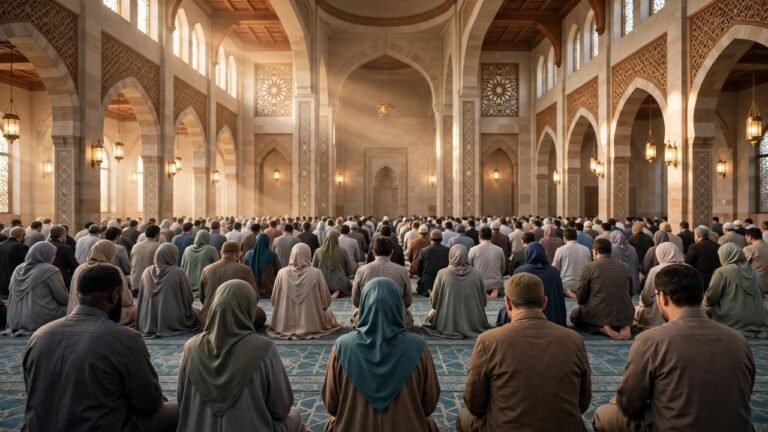
The five daily prayers in Islam are Fajr, Dhuhr, Asr, Maghrib, and Isha. Together they add up to 17 obligatory rak’ahs a day, spread from dawn to night. This guide gives you each prayer’s name, time window, and rak’ah count, plus a 4-week plan to learn them one at a time. If you cannot read Arabic yet, start with Noorani Qaida first — reading the alphabet comes before reciting the prayers.
Salah is the second pillar of Islam, after the Shahada. The Quran ties prayer to set times: “Establish prayer at both ends of the day and in the early part of the night. Surely good deeds wipe out evil deeds.” (Quran 11:114)
What Are the Five Daily Prayers in Islam?
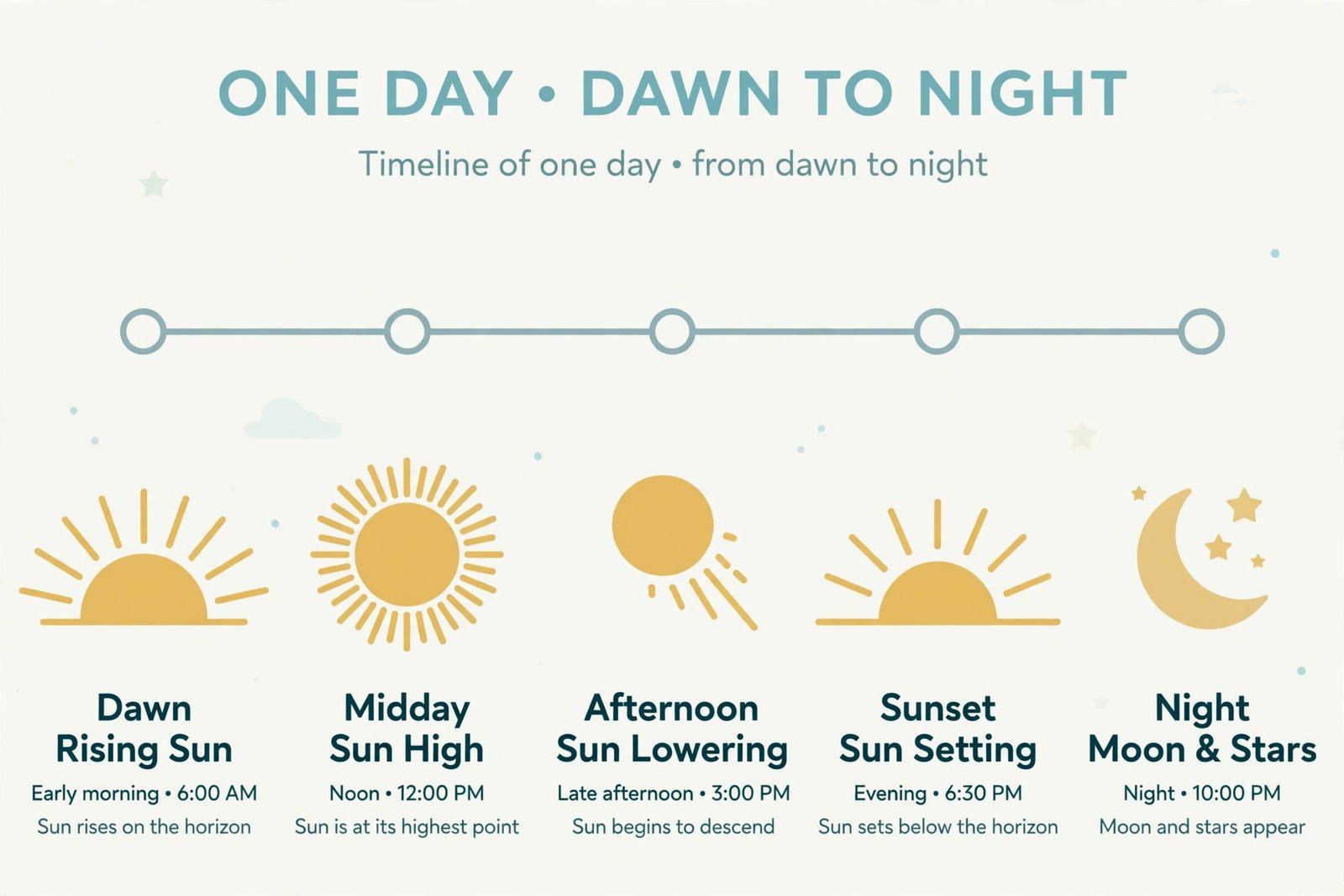
The five daily prayers are Fajr at dawn, Dhuhr at midday, Asr in the afternoon, Maghrib at sunset, and Isha at night. Each one is prayed inside a window set by the sun, so clock times shift a little every day and differ by city.
| Prayer | Meaning | Time window | Fard rak’ahs | Recitation |
|---|---|---|---|---|
| Fajr | Dawn | First light of dawn until sunrise | 2 | Aloud |
| Dhuhr | Midday | Just after the sun passes its highest point until Asr begins | 4 | Silent |
| Asr | Afternoon | Mid-afternoon until just before sunset | 4 | Silent |
| Maghrib | Sunset | Just after sunset until the twilight fades | 3 | First 2 aloud |
| Isha | Night | After twilight disappears until midnight, by preference | 4 | First 2 aloud |
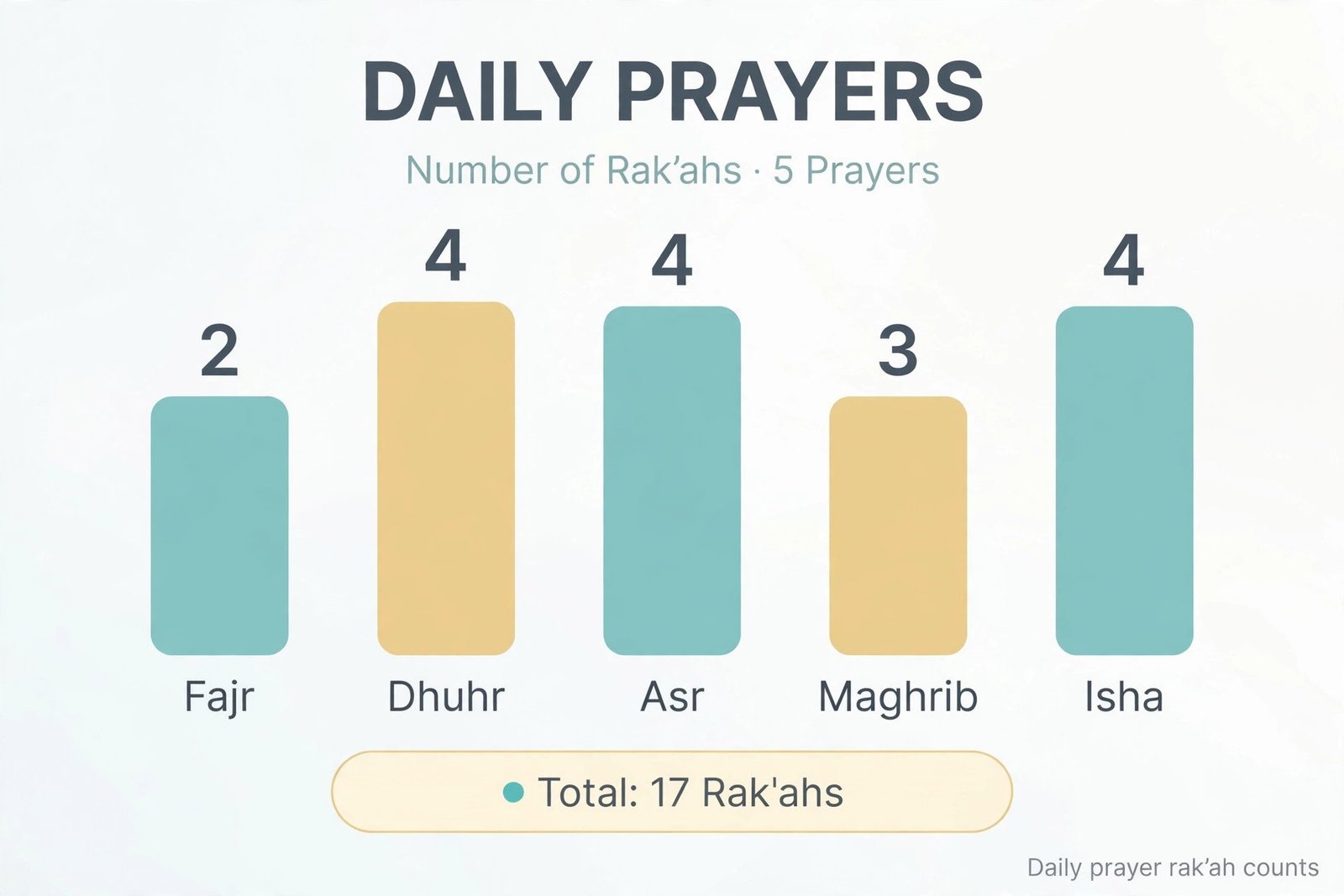
A rak’ah is one unit of prayer: standing and reciting, bowing, rising, two prostrations, and sitting. Every rak’ah includes Surah Al-Fatiha, the opening chapter of the Quran. Fajr has 2 rak’ahs, Dhuhr 4, Asr 4, Maghrib 3, and Isha 4 — 17 in a full day.
When Is Each Prayer Prayed? 5 Windows Tied to the Sun
Each prayer has a window, not a single minute. The window opens and closes with the sun, so times move a few minutes each day and change with the seasons. Check your local mosque timetable or a prayer-time app for your city’s clock times.
Fajr opens at true dawn, when the first light spreads across the horizon, and closes at sunrise. It is the shortest prayer and the one most beginners learn first. The Quran names it directly: “Observe the prayer from the decline of the sun until the darkness of the night and the dawn prayer, for certainly the dawn prayer is witnessed.” (Quran 17:78)
Dhuhr opens just after the sun passes its highest point and runs until Asr begins. For most people it lands near the lunch break, which makes it the easiest prayer to fit into a workday or school day.
Asr runs through the afternoon and ends just before sunset. Its exact start depends on the length of shadows. Our full guide to Asr time covers the shadow rule and the difference in calculation.
Maghrib opens the moment the sun sets and closes when the red twilight fades. It has the shortest window of the five, so most Muslims pray it promptly. During Ramadan, Maghrib is also the moment the fast is broken.
Isha opens once twilight has fully gone and the sky is dark. Its window runs until midnight by preference, though it can be prayed later. It is the last prayer of the day.
How Many Rak’ahs Does Each Prayer Have? 17 Fard, 29 With Sunnah
The five prayers have 17 obligatory (fard) rak’ahs a day: Fajr 2, Dhuhr 4, Asr 4, Maghrib 3, Isha 4. Add the regular sunnah rak’ahs and the daily total is 29.
| Prayer | Fard rak’ahs | Sunnah before | Sunnah after | Total |
|---|---|---|---|---|
| Fajr | 2 | 2 | 0 | 4 |
| Dhuhr | 4 | 4 | 2 | 10 |
| Asr | 4 | 4 optional | 0 | 4 (8 with optional) |
| Maghrib | 3 | 0 | 2 | 5 |
| Isha | 4 | 0 | 2 | 6 |
| Total | 17 | 10 | 6 | 29 |
Start with the 17 fard rak’ahs. That is the duty. The 12 sunnah rak’ahs come after the five fard prayers feel steady, usually in the second or third month. Witr, 3 rak’ahs prayed after Isha, is taught separately by your teacher. Ask a qualified teacher if you are unsure which sunnah rak’ahs apply to you, since details differ between schools of thought.
What 17 Rak’ahs a Day Adds Up To
The daily number looks small. The weekly number shows the real habit.
| Period | Fard rak’ahs | Fard + sunnah rak’ahs | Minutes (fard only) |
|---|---|---|---|
| 1 day | 17 | 29 | about 25 |
| 1 week | 119 | 203 | about 175 |
| 1 month (30 days) | 510 | 870 | about 750 |
| 1 year | 6,205 | 10,585 | about 9,125 |
Minutes assume about 5 minutes per fard prayer for a reader who knows the words. A new learner takes longer at first, around 7 to 8 minutes per prayer, and speeds up as the words become familiar. At 5 minutes a prayer, the five daily prayers take about 25 minutes a day and under 3 hours a week. That is the full time cost of the habit.
What It Costs to Learn the Prayers With a Teacher
Online Quran classes run $43 to $100 a month. Here is what each plan works out to per lesson.
| Plan | Price per month | Classes per week | Lessons per month | Cost per lesson |
|---|---|---|---|---|
| Starter | $43 | 2 | 8 | $5.38 |
| Standard | $55 | 3 | 12 | $4.58 |
| Intensive | $75 | 4 | 16 | $4.69 |
| Family | $100 | 5 shared | about 20 shared | $5.00 shared |
Cost per lesson is the monthly price divided by the lessons in the plan. The Standard plan gives the lowest cost per lesson at $4.58, and it is the plan most families pick for steady progress. Every plan includes a free trial class, and no card is required to book it. The Family plan shares 5 classes a week across 2 to 3 students, with a separate teacher for each child.
Which Prayer Should You Learn First?
Learn Fajr first. It has 2 rak’ahs, so it is the shortest prayer, and it teaches the full shape of a prayer — standing, reciting, bowing, prostrating, sitting — in the fewest steps. Use this decision tree to pick your own starting point.
You cannot read Arabic letters yet? Start with Noorani Qaida and learn Fajr at the same time. Your teacher teaches the letters in class and the Fajr words line by line. Learn how long Noorani Qaida takes.
You can read Arabic but you are new to prayer? Start with Fajr, then add Maghrib. Maghrib has 3 rak’ahs and the shortest window, so it teaches you to pray on time. Add Dhuhr, Asr, and Isha one at a time after that.
You already pray 1 or 2 prayers? Add the next prayer in the order of the day, and keep the ones you have steady for 2 weeks before adding another. Adding one prayer every 2 weeks gets you to all five in about 8 weeks without losing the ones you started with.
You are teaching a child? Start with the prayer the family prays together, usually Maghrib in the evening when everyone is home. One prayer a day, prayed with a parent, beats five prayers taught in a rush. Read the guide on the best age to start Quran classes.
How Do You Learn All Five Prayers in 4 Weeks?
Say you are an adult beginner who cannot read Arabic yet. You book 3 classes a week, 30 minutes each, and you practice 10 minutes a day at home. Here is what the 4 weeks look like.
- Week 1: Wudu and Fajr. Your teacher teaches the wudu steps first, then the movements of Fajr and the first lines of Surah Al-Fatiha. You practice wudu twice a day and repeat the Fajr words from a transliteration card. By the end of the week you can pray Fajr slowly, reading the words from the card.
- Week 2: Maghrib and the rest of Al-Fatiha. You finish Al-Fatiha and add Maghrib, which uses the same movements as Fajr with one extra rak’ah. You now pray 2 prayers a day.
- Week 3: Dhuhr and Asr. These two are 4 rak’ahs each and silent, so they teach the middle sitting and the longer pattern. Add one on Monday and one on Thursday. You now pray 4 prayers a day.
- Week 4: Isha and the full day. You add Isha, the last prayer, and pray all five every day for 7 days. Your teacher checks your recitation in class and fixes any words you have been saying wrong.
That is 12 classes and about 280 minutes of home practice across the month. Most adult beginners need 4 to 8 weeks at this pace, because Al-Fatiha takes longer for some people than for others. If you already read Arabic, the same plan often takes 2 to 3 weeks. The plan above is a worked example with stated assumptions, not a promise.

How Much Time Do the Five Prayers Take Each Day?
The five fard prayers take about 25 minutes a day once you know the words — about 5 minutes each. Add the 12 sunnah rak’ahs and the total rises to about 40 minutes a day. That is the whole daily cost of the habit.
Learning time is separate. During the first month, plan for 30 minutes of class 3 times a week plus 10 minutes of practice a day: 160 minutes a week. After the first month, the class time drops away and only the 25 minutes of daily prayer stays.
What 5 Mistakes Slow Beginners Down?
1. Trying all five prayers on day one. Five new sets of words at once is too much to hold. The cost: you mix the prayers up, feel behind, and stop. Learn Fajr first and add one prayer every 1 to 2 weeks.
2. Skipping wudu practice. Prayer needs wudu first, and wudu has its own steps. The cost: you reach the prayer mat and have to stop and start over. Learn the wudu steps in week 1, before you worry about getting every word right.
3. Rushing the movements. New learners often race through bowing and prostration to get to the end. The cost: the words blur together and the prayer feels like a race. Pause in each position until you are still, then move on. Speed comes on its own after a few weeks.
4. Waiting until you can read Arabic fluently. Some beginners delay prayer for months while they finish the alphabet. The cost: months with no prayer habit at all. Learn Al-Fatiha line by line from transliteration while you study Qaida. The two tracks run together, and your teacher checks both.
5. Learning alone with no feedback. Pronunciation errors you practice alone become habits. The cost: months of unlearning later, when a teacher finally hears them. One weekly class catches errors in the first week, when they are easy to fix. Online Quran classes give you that weekly check without leaving home.
Your Daily Prayer Checklist
Tick each prayer as you pray it. Aim for 5 ticks a day, and count a week with 35 ticks as a full week.
- Fajr — 2 rak’ahs [ ]
- Dhuhr — 4 rak’ahs [ ]
- Asr — 4 rak’ahs [ ]
- Maghrib — 3 rak’ahs [ ]
- Isha — 4 rak’ahs [ ]
- Wudu done before each prayer [ ]
- Al-Fatiha recited from memory, not from the card [ ]
- 10 minutes of practice or revision [ ]
Weekly tracker: write the number of prayers you prayed each day. 35 is a full week. 25 or more is a strong week. Below 15, pick one prayer and make only that one steady for the next 7 days, then add the next.
How Does a 30-Minute Online Class Teach the Prayers?
A typical 30-minute class follows one shape. Your teacher checks your wudu and your recitation of what you learned last time, teaches 2 to 3 new lines of Al-Fatiha, practices one full prayer with you start to finish, and sets 10 minutes of homework. Classes are live and one-to-one, with a certified male or female teacher, for kids and adults worldwide. Classes run $43 to $100 a month, and the Standard plan at $55 a month gives the 3-classes-a-week pace used in the 4-week plan above.
Frequently Asked Questions
How many rak’ahs are in the five daily prayers?
The five prayers have 17 obligatory (fard) rak’ahs a day: Fajr 2, Dhuhr 4, Asr 4, Maghrib 3, and Isha 4. With the regular sunnah rak’ahs added, the daily total is 29.
What is the shortest prayer to learn first?
Fajr is the shortest, with 2 rak’ahs. Learn it first, then add Maghrib with 3 rak’ahs, then the three 4-rak’ah prayers one at a time.
Do I need to know Arabic before I start praying?
No. Learn Surah Al-Fatiha line by line from transliteration while you study Noorani Qaida. Your teacher checks your pronunciation each week.
What if I miss a prayer?
Pray it as soon as you can. If you miss prayers often, set a fixed time for each one and use the checklist above to track the week. Ask a qualified teacher about making up missed prayers.
Can children pray fewer than five prayers while learning?
Yes. Teach one prayer at a time, usually the one the family prays together, and add the next one after 2 weeks of steady practice. Most families start with Maghrib in the evening.
How long does it take to learn all five prayers?
Most adult beginners need 4 to 8 weeks at 3 classes a week with 10 minutes of daily practice. If you already read Arabic, the same plan often takes 2 to 3 weeks.
Are prayer times the same everywhere?
No. Prayer times follow the sun, so they shift a few minutes each day and differ by city and season. Use your local mosque timetable or a prayer-time app for your city’s clock times.
Book a Free Trial Class
Try one free 30-minute class with a certified male or female teacher, no card required. Your teacher will check your level and set a plan for the five prayers. Book your free trial class.
Related Guides: What Time Is Asr? — How Long Does It Take to Learn Noorani Qaida? — How to Learn Quran Online — What Is the Shahada? — Best Age for Kids to Start Quran