Asr begins in the afternoon, but there is no single clock time for it. Its start depends on the sun’s position and, in modern prayer timetables, the calculation method being used. The obligatory Asr prayer is four fard rak‘ahs, prayed quietly, and its prayer time reaches sunset. If you see two different Asr times on different apps, the difference is usually a matter of the juristic calculation method rather than one timetable simply being wrong.
That distinction matters.
If you are looking for today’s exact Asr time, you need your city, date, and calculation method. If you want to understand what makes that time “Asr,” keep reading.
When does Asr time begin?
This is where the answer gets more interesting than “sometime in the afternoon.”
The Prophet Muhammad ﷺ taught the prayer times in relation to the movement of the sun and the length of shadows. In Sahih Muslim, the time of the afternoon prayer is described in relation to the sun’s position, with the later part of its time extending until the sun becomes pale.
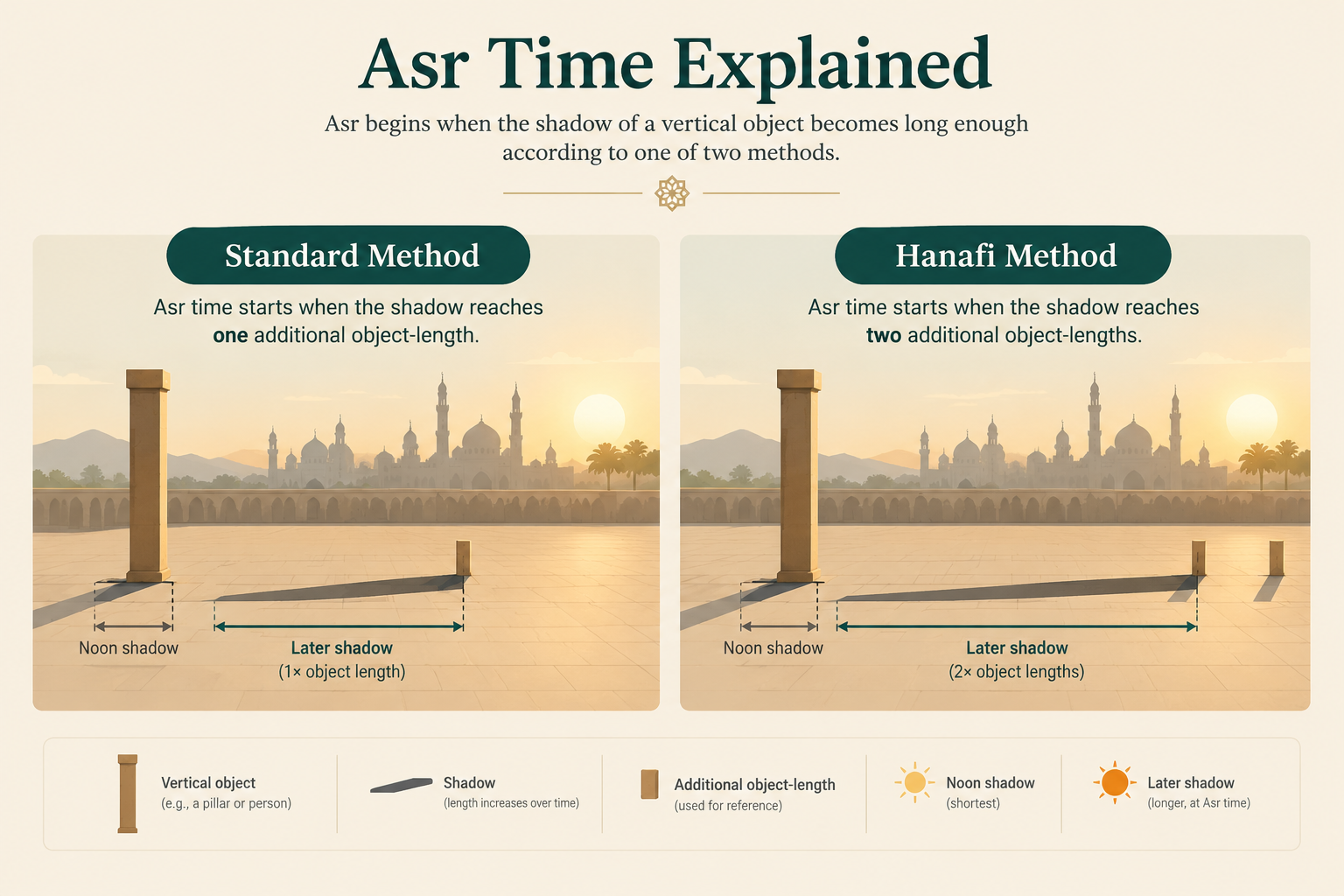
There are two well-known methods for identifying the beginning of Asr.
The standard shadow method
According to the Shafi‘i, Maliki and Hanbali schools, Asr begins when the shadow of an object reaches a length equal to the object itself, in addition to the shadow that existed at solar noon.
That last part is easy to miss.
You do not simply take a stick, wait until its shadow is exactly as long as the stick, and ignore the shadow that was already there at noon. The noon shadow is part of the calculation.
The Hanafi method
The Hanafi school places the beginning of Asr later: when the object’s shadow reaches twice the object’s length, again accounting for the shadow already present at noon.
That is why two respectable prayer timetables can give different Asr times.
This is not necessarily an error in either app. They may simply be using different juristic settings.
For someone who follows the Hanafi school, particularly in communities where Hanafi prayer timetables are customary, choosing a timetable configured for Hanafi Asr is the sensible approach. If you follow another school, use its established calculation consistently.
You do not need to stand outside every afternoon with a measuring stick.
Use a reliable local prayer timetable and know which calculation method it follows.
When does Asr end?
Asr ends at sunset.
There is an important qualification here: the Prophet ﷺ described an earlier, better portion of the Asr period and warned against deliberately pushing the prayer toward the point when the sun is becoming pale or yellow. Sahih Muslim records this distinction in its discussion of the prayer times.
So think of the day in two ways:
The prayer has a valid time window. But not every part of that window is equally good for delaying the prayer.
That is why “Asr lasts until sunset” should never be taken as an invitation to wait until the final few minutes.
Pray it early.
The Prophet ﷺ also said that whoever catches one rak‘ah of Asr before sunset has caught Asr. This is reported in Sahih al-Bukhari and Sahih Muslim.
That hadith is especially useful when someone gets caught unexpectedly. But it should not become a habit of praying at the last possible moment.
Why do different apps show different Asr times?
This is one of the most common sources of confusion.
Imagine two prayer apps show:
- Asr: 4:15 PM
- Asr: 5:05 PM
A person might reasonably think one of them is wrong.
Before accusing either one, check the Asr calculation setting.
One may be using the standard shadow ratio, while another is using the Hanafi ratio. Because the Hanafi calculation places the start later, the difference can be substantial, especially depending on the season and location.
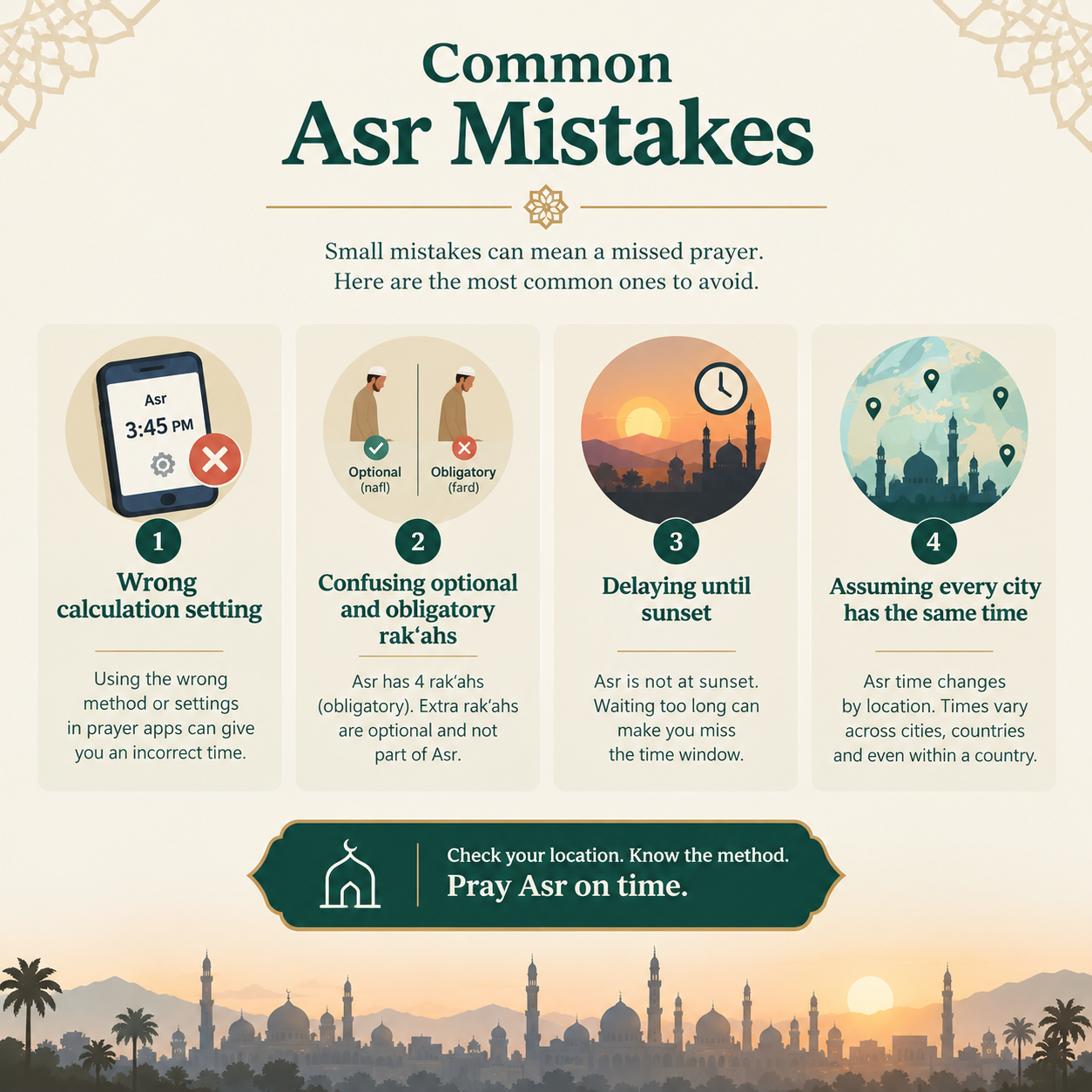
There is another reason not to copy a prayer time from someone else’s phone: your location matters.
The sun does not reach the same position over Lahore, London, Toronto and Dubai at the same clock time. Even nearby cities can have different prayer times.
So if someone asks, “What time is Asr?” the honest answer is:
What city, what date, and which calculation method?
For today’s exact time, check a reliable local timetable rather than relying on a generic article.
How many rak‘ahs is Asr?
The obligatory Asr prayer is four fard rak‘ahs.
That is the number to remember if you are learning the prayer for the first time.
There is also a recommended voluntary prayer before Asr. The Prophet ﷺ said:
“May Allah have mercy upon a man who prays four before Al-Asr.”
This report is recorded in Jami‘ at-Tirmidhi 430, which grades the hadith as hasan.
Those four rak‘ahs are not part of the four fard rak‘ahs.
This distinction saves beginners a lot of unnecessary confusion. If you pray only the four obligatory rak‘ahs of Asr, you have performed the required Asr prayer. The additional prayer before it is voluntary/recommended, with differences in fiqh terminology and emphasis between schools.
So, at the simplest level:
Before Asr: four voluntary rak‘ahs are recommended.
Asr itself: four fard rak‘ahs are obligatory.
Is Asr prayed silently?
Yes.
Asr is a quiet prayer, like Dhuhr.
This does not mean you merely think the words in your head. You recite the Qur’an quietly rather than reciting aloud as the imam does in the audible prayers.
The Prophet’s practice of reciting in Dhuhr and Asr is recorded in Sahih al-Bukhari. One narration describes the Companions knowing that he was reciting from the movement of his beard, which illustrates that the recitation was quiet.
For someone praying alone, keep the recitation low enough that it is not an audible public recitation.
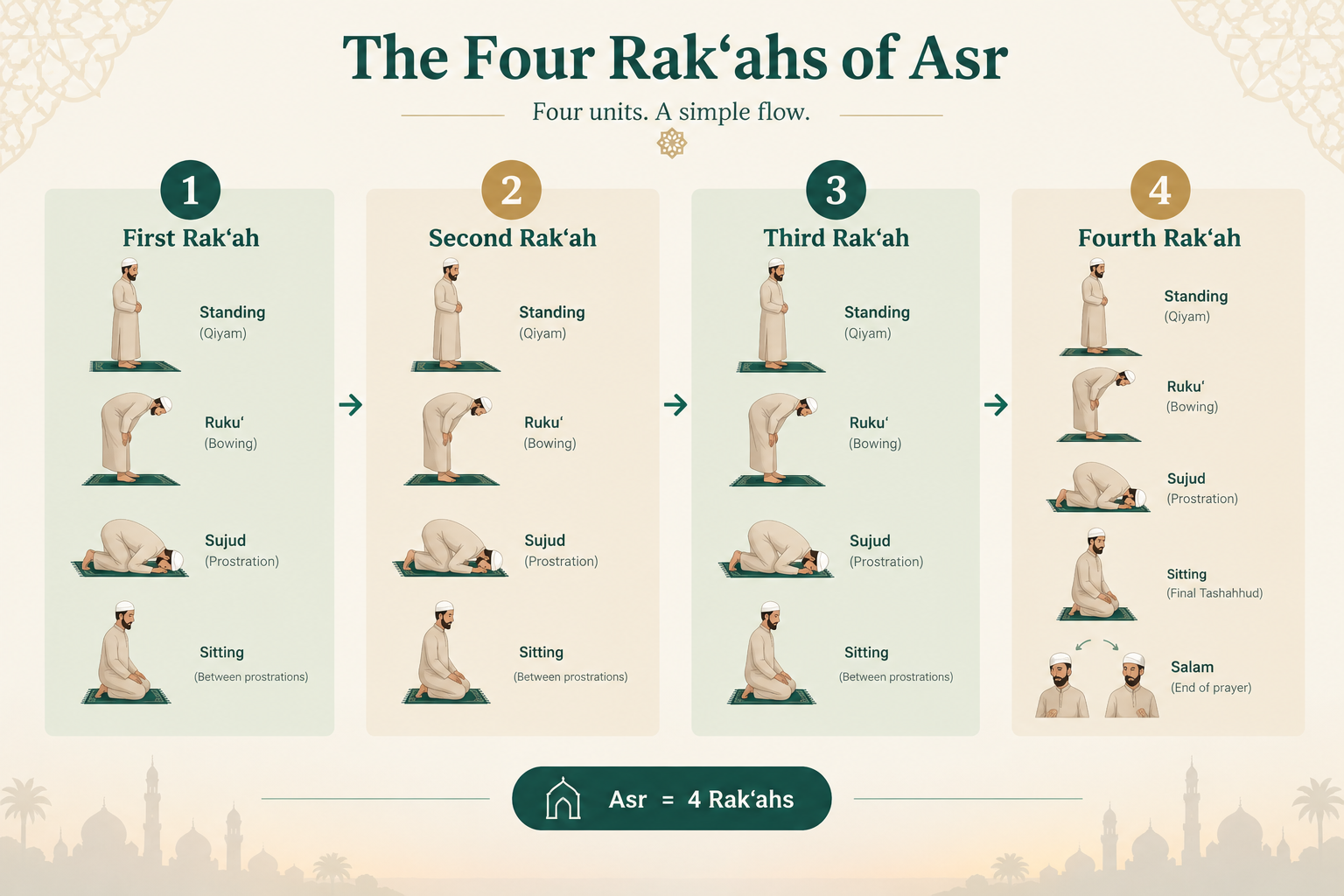
How do you pray the four fard rak‘ahs of Asr?
If you already know how to pray Dhuhr, the four fard rak‘ahs of Asr follow the same basic structure.
Before beginning, make sure you have wudu, your prayer area and clothing meet the requirements of salah, you are facing the qiblah, and the Asr prayer time has entered.
Then:
1. Make the intention
Make the intention in your heart to pray the four obligatory rak‘ahs of Asr for Allah.
You do not need to turn the intention into a long sentence.
The point is that you know which prayer you are about to perform.
2. Begin with takbir
Stand facing the qiblah and say:
Allahu Akbar
Begin the prayer.
Follow the normal opening procedure you have learned from your teacher or school of fiqh.
3. Pray the first rak‘ah
While standing, recite Surah al-Fatihah, followed by another portion of the Qur’an.
Then perform ruku‘.
After rising from ruku‘, perform the two sujuds with the normal sitting between them.
That completes the first rak‘ah.
4. Pray the second rak‘ah
Stand for the second rak‘ah.
Again, recite al-Fatihah and additional Qur’an, then perform ruku‘ and the two sujuds.
After the second rak‘ah, sit for the first tashahhud.
Do not finish the prayer here. Asr has four obligatory rak‘ahs.
5. Stand for the third rak‘ah
Rise for the third rak‘ah.
Continue the prayer according to the method you follow. In the common Sunni form, the third and fourth rak‘ahs of a four-rak‘ah obligatory prayer contain al-Fatihah, followed by ruku‘ and sujud.
There are details of recitation and what is considered required or recommended that differ between schools. If your teacher has taught you a particular madhhab’s method, follow that method rather than mixing details from several guides.
6. Pray the fourth rak‘ah
The fourth rak‘ah follows the same basic pattern.
After its two sujuds, sit for the final tashahhud.
Recite the tashahhud and the prescribed blessings upon the Prophet ﷺ according to the form you have learned.
7. Finish with salam
Turn to the right and then to the left, saying the salam that concludes the prayer.
Your four fard rak‘ahs of Asr are complete.
What should you recite in the first two rak‘ahs?
The Prophet ﷺ is reported to have recited al-Fatihah along with another surah in the first two rak‘ahs of Dhuhr and Asr.
For a beginner, there is no need to make this complicated.
Learn al-Fatihah properly first. Then learn a few short surahs and use them in your prayer.
If you are studying with a Quran teacher, this is a good place to ask for correction. Correct Arabic pronunciation matters in salah, and reading Qur’an with proper Tajweed is one reason structured Quran instruction is so valuable.
Why does the Qur’an give special attention to the middle prayer?
Allah says in Surah al-Baqarah:
“Observe the ˹five obligatory˺ prayers—especially the middle prayer…”
The majority of scholars identify the “middle prayer” in this verse as Asr. Tafsir Ibn Kathir records this as the position of the majority of scholars among the Companions and later authorities, while also documenting that other interpretations were reported.
The identification is also supported by hadith in which the Prophet ﷺ referred to Asr as the middle prayer.
That gives Asr a particular emphasis.
And the warning about missing it is equally direct. In Sahih al-Bukhari, the Prophet ﷺ said that whoever misses Asr is as though he has lost his family and property.
The point is not to make someone panic over every small timing mistake.
It is to show the seriousness of deliberately neglecting a prayer Allah has commanded us to guard.
What if you are running late for Asr?
First, do not give up because you think you are “too late.”
If the sun has not set, the Asr prayer time has not simply disappeared because you missed the earlier preferred portion.
Pray.
And if sunset is very close, do not spend your remaining time debating whether you should still start. The Prophet ﷺ specifically taught that catching one rak‘ah of Asr before sunset counts as catching the prayer.
The better habit, though, is to build Asr into your day before the deadline becomes a problem.
If work, school, travel or family responsibilities repeatedly push Asr toward sunset, change the routine rather than relying on the last few minutes.
That is much safer.
Common mistakes people make with Asr
Mistake 1: Assuming one clock time applies everywhere
There is no universal “Asr is at 4:00 PM” rule.
Prayer times move with the sun, the date and your location.
Mistake 2: Thinking every different app must contain an error
Check the calculation method first. A Hanafi timetable and a standard-shadow timetable can legitimately show different Asr start times.
Mistake 3: Treating the four optional rak‘ahs as part of the obligation
The obligatory Asr prayer is four fard rak‘ahs.
The recommended four before it are separate.
Mistake 4: Waiting until sunset because “I still have time”
Technically having time left is not the same as choosing the best time to pray.
The Prophet ﷺ warned against delaying Asr until the sun becomes pale, so make early prayer your normal habit.
Mistake 5: Getting distracted by minor differences between prayer schools
There are legitimate differences in some details of salah.
A beginner does not need to collect every opinion before praying.
Learn one sound method from a qualified teacher, understand what is obligatory, and become consistent.
The simplest way to remember Asr
If you remember nothing else from this article, remember these five points:
Asr is the third daily prayer.
Its obligatory prayer is four fard rak‘ahs.
It is prayed quietly.
Its start is determined by the sun’s shadow, with different established calculation methods between schools.
Its time ends at sunset, but it should not be deliberately delayed toward the end.
And if you are checking today’s exact Asr time, do not use a generic article to make the final decision. Use a reliable prayer timetable for your city and check whether it is set to the calculation method you follow.
That one habit removes most of the confusion.
If you are still learning the physical steps of salah, the best next step is to practise the four rak‘ahs with a qualified Quran or Islamic studies teacher until the sequence becomes natural.