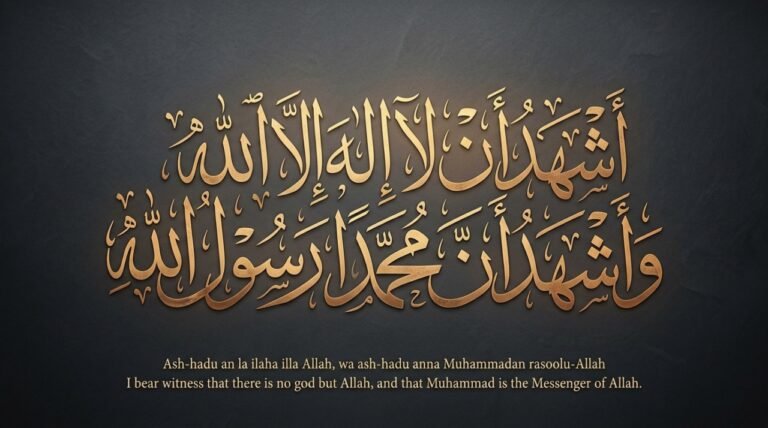
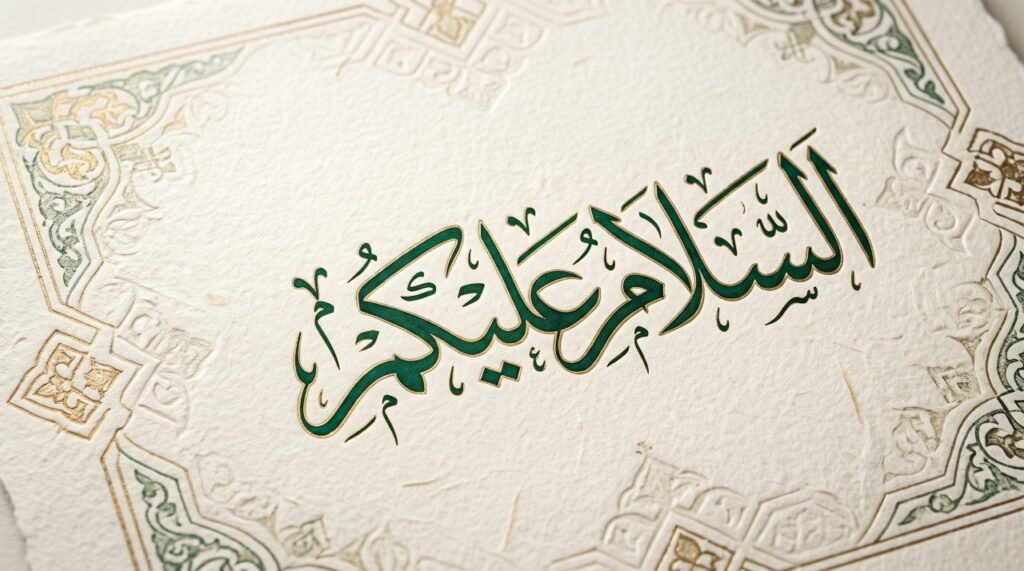
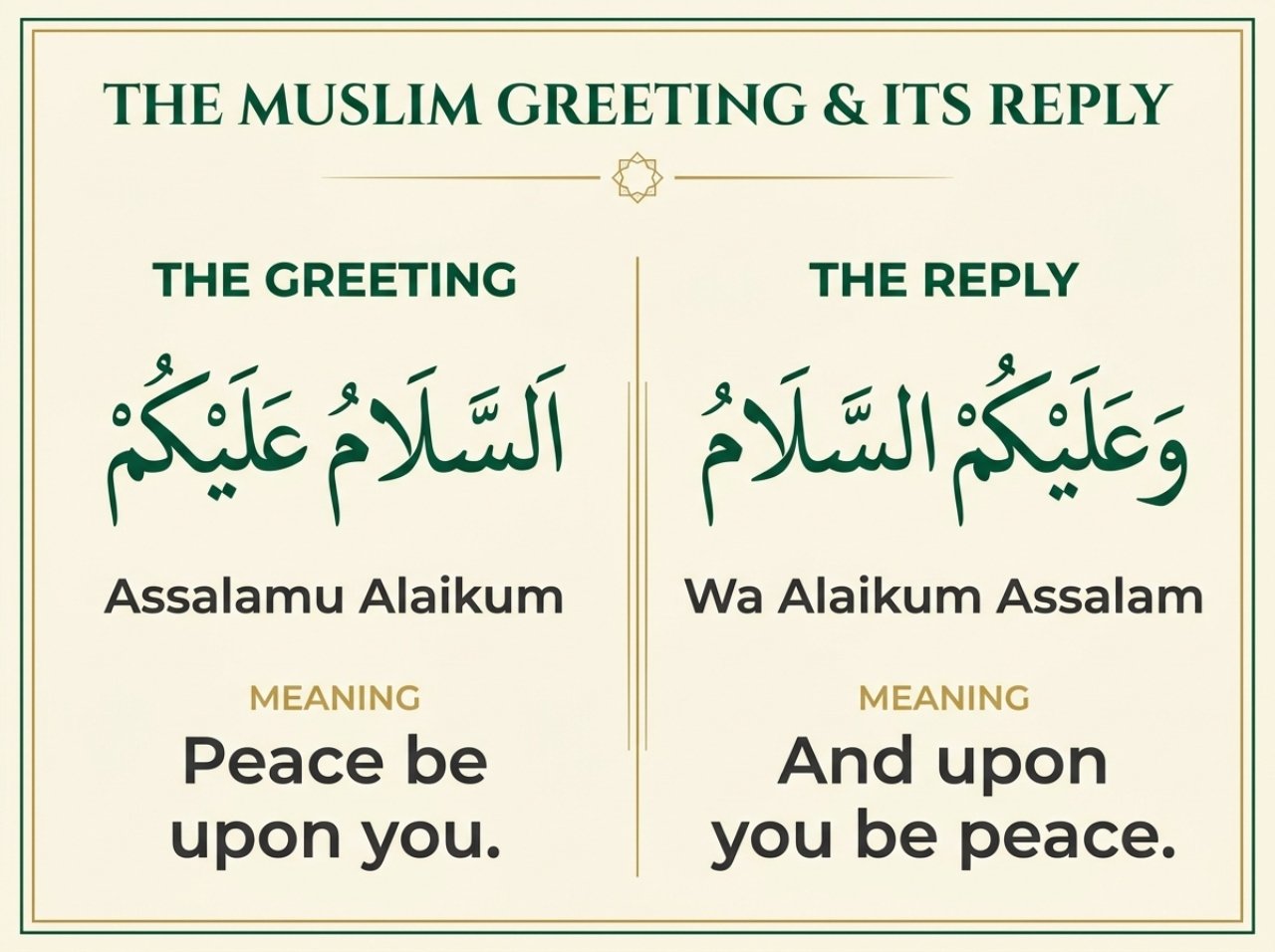
The most widely recognised Muslim greeting is Assalamu Alaikum (السلام عليكم), an Arabic phrase meaning “Peace be upon you.” The usual response is Wa Alaikum Assalam (وعليكم السلام), meaning “And upon you be peace.”
Muslims use this greeting to welcome one another, begin conversations, and express a wish for peace and well-being. You may hear it at a mosque, at home, among friends, at work, or in messages.
Whether you are Muslim, learning about Islam, or simply hoping to greet a Muslim friend respectfully, this guide explains what the greeting means, how to pronounce it, how to reply, and when it is commonly used.
What Is the Muslim Greeting?
The traditional Muslim greeting is As-salamu Alaikum, also commonly written as Assalamu Alaikum or Assalamualaikum.
In Arabic, it is written:
السلام عليكم
Transliteration: As-salāmu ʿalaykum
English meaning: Peace be upon you.
The greeting is deeply associated with Islamic manners and the practice of spreading peace among people. Muslims around the world use it regardless of their first language, although pronunciation and everyday customs may vary between communities.
Although the phrase is widely recognised as the Islamic greeting, it is Arabic in origin and is not exclusive to Arabic-speaking Muslims. Its central message is a wish for peace, rather than simply a casual hello.
What Does Assalamu Alaikum Mean?
Assalamu Alaikum means “Peace be upon you.” It expresses a wish for peace, safety, and well-being for the person being greeted.
The phrase can be understood in two parts:
- As-salamu (السلام): The peace.
- Alaikum (عليكم): Upon you.
Together, these words form a greeting that offers peace to another person. For Muslims, saying it can also express religious devotion and a commitment to good manners.
The Quran addresses the importance of returning greetings in Surah An-Nisa 4:86. It instructs believers to return a greeting with one that is better or at least equivalent. This verse provides an important foundation for understanding why the response to salam matters in Islamic practice.
The greeting is therefore more meaningful than a routine exchange of words. It combines courtesy with a positive wish for another person’s well-being.
How Do You Reply to Assalamu Alaikum?
The standard response to Assalamu Alaikum is Wa Alaikum Assalam, meaning “And upon you be peace.”
The following table explains common forms of the greeting and its response.
| Greeting | Meaning | Appropriate response |
|---|---|---|
| Assalamu Alaikum | Peace be upon you | Wa Alaikum Assalam |
| Assalamu Alaikum wa Rahmatullah | Peace be upon you and Allah’s mercy | Wa Alaikum Assalam wa Rahmatullah |
| Assalamu Alaikum wa Rahmatullahi wa Barakatuh | Peace be upon you, and Allah’s mercy and blessings | Wa Alaikum Assalam wa Rahmatullahi wa Barakatuh |
The longer forms include additional wishes for Allah’s mercy and blessings. A well-known narration in Sunan Abi Dawud 5195 describes greetings using progressively longer forms and associates them with increasing rewards.
The Quran’s guidance in 4:86 encourages returning a greeting equally or with something better. The table provides common forms, not a complete ruling for every possible situation.
Example of a Muslim greeting exchange
Person A: Assalamu Alaikum.
Persn B: Wa Alaikum Assalam.
Person A: How are you?
Person B: Alhamdulillah, I’m well. How about you?
This short exchange demonstrates how the greeting can naturally lead into an ordinary conversation. You do not need to memorise a long Arabic expression to begin using the standard greeting and response.
What Is the Difference Between Salam and Assalamu Alaikum?
Salam (سلام) means “peace.” It is also commonly used as a shortened greeting in many Muslim communities.
Assalamu Alaikum is the fuller, traditional greeting, while salam may be used more casually depending on the language, culture, and relationship between speakers.
Here is a simple comparison:
| Expression | Meaning | Common use |
|---|---|---|
| Salam | Peace | Short, informal greeting in many communities |
| Assalamu Alaikum | Peace be upon you | Traditional Muslim greeting |
| Wa Alaikum Assalam | And upon you be peace | Reply to the greeting |
| Assalamu Alaikum wa Rahmatullahi wa Barakatuh | Peace, Allah’s mercy, and His blessings be upon you | Extended greeting |
Usage varies between families, regions, and languages. A short salam between friends is not necessarily intended to replace the full expression in every religious or formal setting.
If you are learning the greeting for the first time, start with Assalamu Alaikum and Wa Alaikum Assalam. These two expressions will help you recognise and participate in the most familiar form of the exchange.
How to Pronounce Assalamu Alaikum
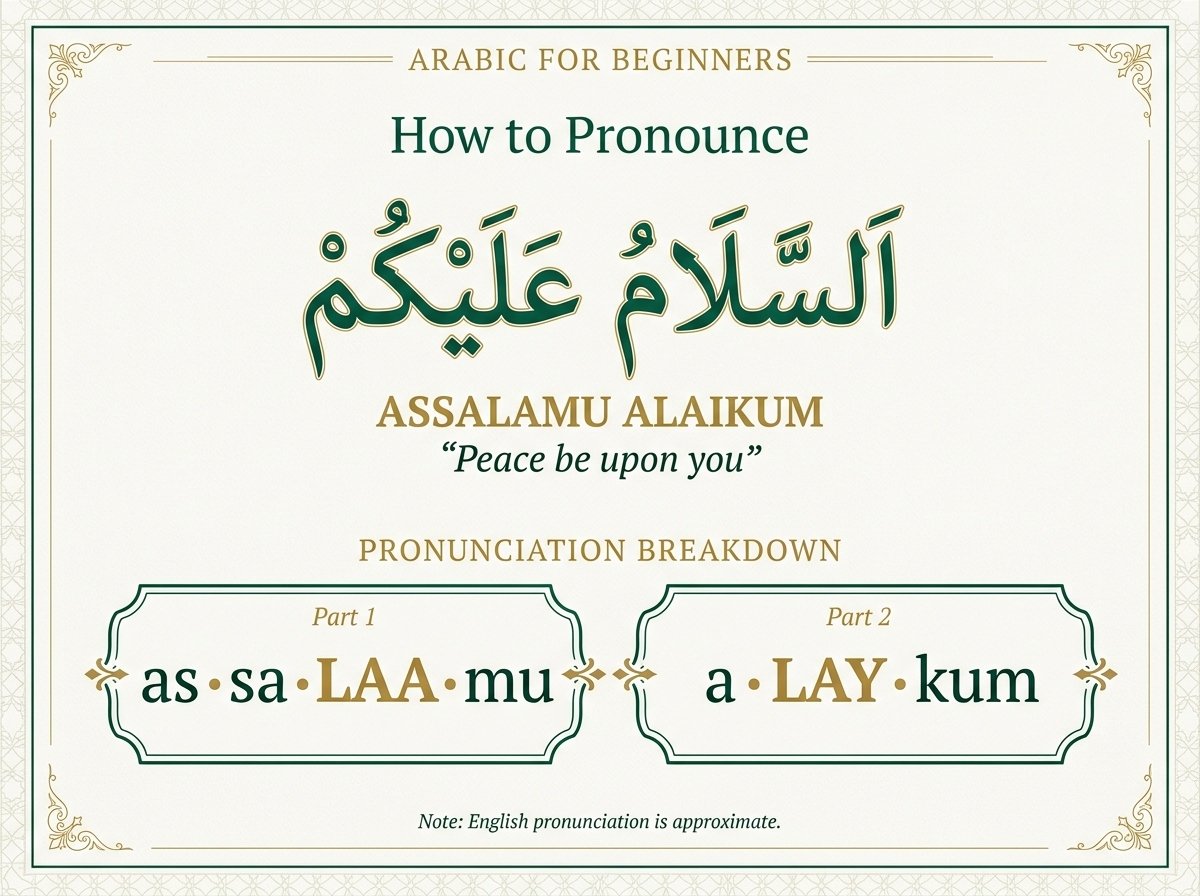
A practical English approximation of the pronunciation is:
As-sa-LAA-mu a-LAY-kum
Try breaking the phrase into smaller parts:
- As-sa: Begin with a soft “as-sa” sound.
- Laa: Lengthen the “aa” vowel slightly.
- Mu: Finish the first word with “mu.”
- A-lay-kum: Continue with “a-lay-kum.”
The Arabic transliteration is as-salāmu ʿalaykum. The Arabic letter ʿayn in ʿalaykum does not have an exact English equivalent, so the pronunciation above is only an approximation.
You may encounter different English spellings, including Assalamualaikum, As-salamu alaykum, and Salaam Alaikum. These generally represent the same greeting rather than different expressions.
If you want to improve your pronunciation, listen to a reliable Arabic-language recording and practise slowly. Learners who want precise Arabic pronunciation can also seek feedback from a qualified Arabic teacher.
When Do Muslims Say Salam?
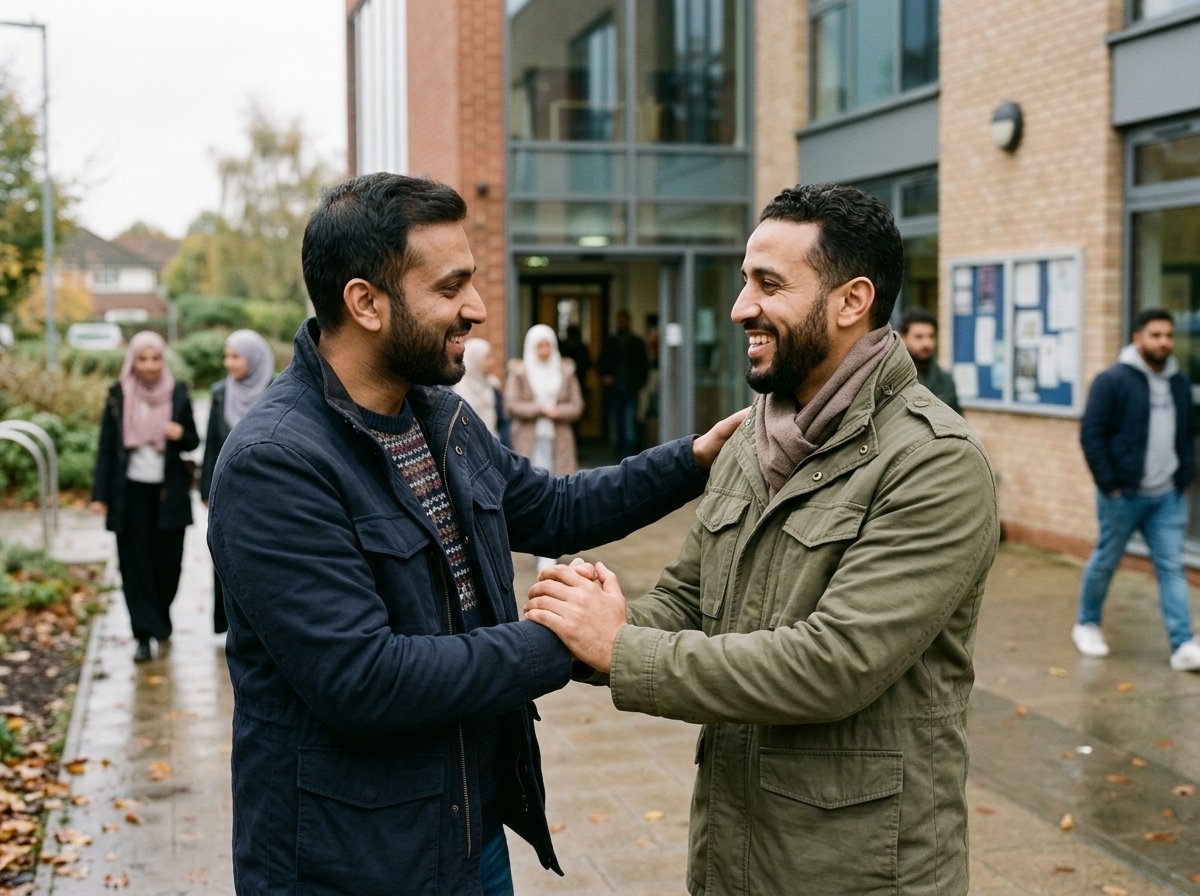
Muslims commonly exchange salam when meeting people, entering homes, attending gatherings, and beginning conversations.
The greeting can be used in many everyday situations.
1. When meeting family and friends
A Muslim may greet a relative or friend with Assalamu Alaikum when arriving home or meeting them outside.
For example:
“Assalamu Alaikum! It is good to see you.”
The other person can respond with Wa Alaikum Assalam before continuing the conversation.
2. When entering a home
Greeting people when entering a home is an established part of Islamic etiquette. Surah An-Nur 24:61 refers to greeting one another when entering houses.
The precise practice may differ depending on whether someone is entering their own home, visiting another household, or finding the home empty.
3. At a mosque or Islamic gathering
Salam is commonly exchanged when Muslims meet at a mosque, attend a class, or join a community event. It can be a welcoming way to begin a conversation with someone familiar or someone they have not met before.
4. At school or work
Muslims may greet Muslim classmates, colleagues, and other people with Assalamu Alaikum. The greeting can fit naturally into professional and educational settings.
For example:
“Assalamu Alaikum. I wanted to ask you about tomorrow’s meeting.”
The greeting does not need to make the conversation formal or lengthy. It simply provides a respectful opening.
5. In text messages and online conversations
Many Muslims begin messages with salam, particularly when communicating with family, friends, teachers, or members of their community.
For example:
“Assalamu Alaikum. I hope you are doing well. Could you please send me the notes from today’s lesson?”
This is a practical way to use the greeting in digital communication while keeping the message clear and natural.
Muslim Greeting Etiquette: What Should You Know?
The greeting of salam is associated with courtesy, kindness, and the spreading of peace. A few simple principles can help you use it appropriately.
Return the greeting. The Quran’s guidance in Surah An-Nisa 4:86 teaches that a greeting should be returned with something better or at least an equivalent greeting.
Be sincere and respectful. Say the greeting clearly and warmly. Its purpose is to acknowledge another person, not to demonstrate how much Arabic you know.
Learn the standard response. If someone greets you with Assalamu Alaikum, replying Wa Alaikum Assalam is a useful starting point.
Respect local customs. Some communities use the full expression more consistently, while others commonly use shortened forms in casual conversations.
Do not assume everyone follows identical customs. Cultural practices and interpretations of religious etiquette can vary. Physical greetings, including handshakes, also depend on personal preferences and community norms.
The Prophet Muhammad’s teachings encourage spreading salam among people. Sahih Muslim 54 is a commonly cited narration on this subject, connecting the spread of greetings with building love among believers.
These principles make the greeting both a religious expression and an everyday practice of good manners.
Can Non-Muslims Say Assalamu Alaikum?
A non-Muslim who wants to greet a Muslim respectfully may wonder whether using Assalamu Alaikum is appropriate.
The phrase is widely recognised as a Muslim greeting, and understanding its meaning can help people from different backgrounds communicate respectfully. Many people appreciate a sincere effort to recognise their customs.
However, Islamic scholarly discussions address the question of initiating salam with non-Muslims in different ways, and the details should not be reduced to a universal religious ruling.
If you are unsure what to say, a friendly “Hello” or “Good morning” is always a practical option. If you choose to use Assalamu Alaikum, learning the meaning and the expected response can help you feel more confident.
For a specific question about religious permissibility, consult a qualified scholar who can explain the relevant evidence and scholarly interpretations.
Frequently Asked Questions About Muslim Greetings
What is the most common Muslim greeting?
Assalamu Alaikum is the best-known traditional Muslim greeting. It means “Peace be upon you” and is used by Muslims around the world.
What does Wa Alaikum Assalam mean?
Wa Alaikum Assalam means “And upon you be peace.” It is the standard response to Assalamu Alaikum.
Is Salam the same as Assalamu Alaikum?
Not exactly. Salam means “peace” and can be used as a short greeting. Assalamu Alaikum is the fuller expression meaning “Peace be upon you.” The words are closely related and their everyday use varies by community.
What is the full Muslim greeting?
The commonly used extended greeting is Assalamu Alaikum wa Rahmatullahi wa Barakatuh. It means “Peace be upon you, and Allah’s mercy and blessings.”
Can I reply with only Wa Alaikum Salam?
Yes. Wa Alaikum Assalam is the standard response to the basic greeting. When someone uses a longer form, you can return a matching greeting or use a fuller response in accordance with the guidance in Quran 4:86.
Is Assalamu Alaikum only used by Muslims?
The expression is strongly associated with Islamic practice, but Arabic greetings are not always exclusive to one religious group. Arabic-speaking communities may use related expressions across different backgrounds.
Do Muslims say salam when leaving?
Some Muslims use salam when parting, while others use different expressions or follow local customs. The greeting is especially well established when meeting people and beginning interactions.
Conclusion
The Muslim greeting Assalamu Alaikum means “Peace be upon you,” while Wa Alaikum Assalam means “And upon you be peace.” These expressions communicate goodwill and are an important part of Muslim social and religious life.
To start using the greeting, remember three things: learn the standard expression, practise its pronunciation, and know how to respond when someone greets you. Understanding the meaning behind the words makes the exchange more natural and helps you appreciate the role of peace and courtesy in Islamic etiquette.
For a deeper understanding, explore the Quranic guidance on returning greetings in Surah An-Nisa 4:86 and the related teachings about spreading salam.