Belief in holy books is one of the six articles of faith in Islam. It means you believe Allah sent guidance in books to His prophets, and the Quran is the final book. This guide lists the 5 books named in the Quran, explains what Muslims believe about each one, and gives you a 4-week plan to teach them to a child in 10 minutes a day.
If you want to read the Quran yourself, start with the Noorani Qaida course. It teaches the Arabic letters first, so you can open the Quran and read it in its own words.
What Belief in Holy Books Means in Islam: 2 Levels
It means 2 things. You believe in general that Allah sent books to His prophets, and you believe in detail in the books the Quran names. The first level covers books you do not know by name. The second level covers 5 books named in the Quran.
In mainstream Islamic teaching, belief in the books is one of the six articles of faith. The other 5 are belief in Allah, His angels, His messengers, the Day of Judgment, and divine decree. The Quran ties the articles together in one verse: the Messenger believes in what was revealed to him, as do the believers, each one believing in Allah, His angels, His books, and His messengers (Quran 2:285).
The Arabic word for this belief is Kutub, the plural of Kitab, which means book. It is a belief, not a reading list. You do not have to read every earlier book to believe in it. You believe Allah sent it, and you follow the Quran as the final book.
| Level | What it covers | Example |
|---|---|---|
| General belief | Every book Allah sent to a prophet, named or not | A book sent to a prophet whose name you do not know |
| Detailed belief | The books the Quran names | Tawrat, Zabur, Injil, Quran, and the Suhuf of Ibrahim |
A second verse makes the detailed list concrete. It says: “We believe in Allah, and the revelation given to us, and to Abraham, Ismail, Isaac, Jacob, and the Tribes, and that given to Moses and Jesus, and that given to all prophets from their Lord” (Quran 2:136). A third verse gives the same command in direct form: believe in Allah, His Messenger, the Book sent down to His Messenger, and the Scripture sent down before him (Quran 4:136).
The 5 Holy Books Named in the Quran
The Quran names 5 books. Some lists give 4 main books and count the Suhuf separately. Some lists give 6, counting the Pages of Musa as a separate book. The table below gives all 5 named books, so the counting difference does not hide a book from you.
| Book | Prophet who received it | What Muslims believe about it | Status today |
|---|---|---|---|
| Suhuf of Ibrahim (Scrolls) | Ibrahim (Abraham) | Early guidance, mentioned in the Quran (Quran 87:18-19) | Believed lost, no complete copy known |
| Tawrat (Torah) | Musa (Moses) | Guidance and a light (Quran 5:44), law for the Children of Israel | Original message believed changed over time |
| Zabur (Psalms) | Dawud (David) | Prayers and praise, given to Dawud (Quran 4:163) | Believed changed over time, parts remain in the Psalms |
| Injil (Gospel) | Isa (Jesus) | Guidance and a light (Quran 5:46), confirming the Tawrat | Original message believed changed over time, not the same as the modern New Testament |
| Quran | Muhammad (peace be upon him) | Final revelation, confirms what came before (Quran 3:3) | Believed preserved in its original Arabic form |
Read the table from left to right and 3 facts stand out. First, every book had one prophet who received it. Second, every book carried the same core message: worship Allah alone. Third, only the Quran is believed to be preserved in its original form today.
The order in the table is the order of revelation, not an order of importance for a reader today. A Muslim today reads the Quran, learns from it, and believes in the earlier books without following their rulings as a separate law. If a question of religious law comes up, ask a qualified teacher. This article explains the belief, it does not give rulings.
The 3 Earlier Books: Tawrat, Zabur, and Injil
The 3 earlier books are Tawrat, Zabur, and Injil. Each one was revealed to one prophet, for one people, at one time in history. Muslims respect all 3 as originally revealed by Allah.
The Tawrat was given to Musa (Moses). The Quran describes it as containing guidance and a light (Quran 5:44). It gave law and guidance to the Children of Israel. Of the earlier books, the Tawrat is mentioned in the Quran more than any other, which shows how central it was to the people it was sent to.
The Zabur was given to Dawud (David). The Quran says, in short form, “and to Dawud We gave the Zabur” (Quran 4:163). It is a book of prayers and praise, known in English as the Psalms. Muslims believe its original message was praise and worship of Allah.
The Injil was given to Isa (Jesus). The Quran says it was given to him with guidance and a light, confirming the Tawrat that came before him (Quran 5:46). Muslims mean a book revealed to Isa, not the 4 Gospels of the New Testament, which others wrote about Jesus. That distinction matters, and it is the most common source of confusion about this topic. It is covered again in the mistakes section below.
The Quran calls Jews and Christians People of the Scripture (Quran 4:171), because they received earlier books. Muslims are taught to speak about earlier books and their people with respect, even while holding that the Quran is the final and preserved book. The Quran says Allah revealed it confirming what came before, “even as He revealed the Torah and the Gospel” (Quran 3:3).

The Quran: The Final Book in 114 Chapters
The Quran is the final book, and it has 114 chapters, called surahs. It was revealed to the Prophet Muhammad (peace be upon him) over 23 years, and Muslims believe it is the final revelation for all people, valid until the Day of Judgment.
Its position is different from the earlier books in 3 ways. First, it confirms what came before it, instead of replacing the core message. Second, it is believed to be preserved in its original Arabic form, with no change. Third, it is the book Muslims read, recite, memorize, and follow today. The Quran itself says, in short form, “I believe in whatsoever Allah has sent down of the Book” (Quran 42:15).
That is why learning to read the Quran is the practical next step after learning what the books are. The path on this site is 3 courses in order. Noorani Qaida teaches the Arabic letters first. The Quran Reading course builds fluency, with weekly reading targets and a monthly report. The Quran with Tajweed course teaches the rules of recitation, with live correction on every ayah.
You do not need to finish all 114 chapters to start. You start with the letters, then short surahs, then longer reading. A teacher maps your level in the free trial and starts you at the right stage, instead of page 1.
What About the 104 Books?
Some books and websites mention 104 holy books. That number comes from a narration that says 104 books were sent down, with pages given to Seth, Enoch, and Ibrahim, and 10 pages to Musa before the Tawrat. The narration has no reliable chain, according to the scholars who checked it. Muslims are not required to believe in a specific number.
That is an important point, and it is why this article gives 5 named books and a general belief, instead of a fixed total. If a book was sent and you do not know its name, general belief covers it. If a number is quoted with no reliable source, you do not have to accept it as fact.
The same rule applies to the Pages of Musa. Some lists count them as a 6th named book. Others count them as another name for the Tawrat. The Quran mentions “the Books of Abraham and Moses” (Quran 87:18-19), which is why the counting varies. The belief does not change with the count: Allah sent books, the Quran names 5 of them, and the Quran is the final book.
How to Teach Your Child the 5 Books in 4 Weeks: 10 Minutes a Day
Assume a 9-year-old who knows nothing about this topic yet, 10 minutes a day, 5 days a week, with a parent and a teacher. That is 50 minutes a week and 200 minutes in 4 weeks. The plan below uses that time, and nothing else.
Week 1 covers what belief means. Day 1 names the 6 articles of faith. Day 2 explains general belief in 2 sentences. Day 3 explains detailed belief in 2 sentences. Day 4 asks your child to name the 5 books from memory, with help. Day 5 repeats the 2 levels and asks 1 question: what does it mean to believe in a book you have never read?
Week 2 covers the Suhuf and the Tawrat. Day 1 names Ibrahim and the Suhuf. Day 2 names Musa and the Tawrat. Day 3 explains “guidance and a light” in plain words. Day 4 asks your child to match 2 books to 2 prophets. Day 5 repeats Week 1 and Week 2 together, in 10 minutes.
Week 3 covers the Zabur and the Injil. Day 1 names Dawud and the Zabur. Day 2 names Isa and the Injil. Day 3 explains the Injil vs the New Testament in 2 sentences. Day 4 asks your child to name all 4 earlier books in order. Day 5 repeats the 4 earlier books and asks which one came last before the Quran.
Week 4 covers the Quran. Day 1 names the Quran and its 114 chapters. Day 2 explains “final and preserved” in plain words. Day 3 starts the letters, with the Noorani Qaida course if your child cannot read Arabic yet. Day 4 reads 1 short surah together, slowly. Day 5 asks your child to name all 5 books, in order, without help.
Use this checklist on each of the 5 days a week. Tick each line as you go.
- Say the name of 1 book and 1 prophet, out loud, from memory.
- Say 1 fact about that book, in your own words.
- Read 1 short line from the Quran together, slowly.
- Ask 1 question, and let your child answer in full sentences.
- Correct 1 mistake gently, and repeat the right version twice.
- Mark the date and the book you covered, so the teacher can see the work at the next class.
How Long It Takes to Read the Quran Yourself: 34 to 68 Classes
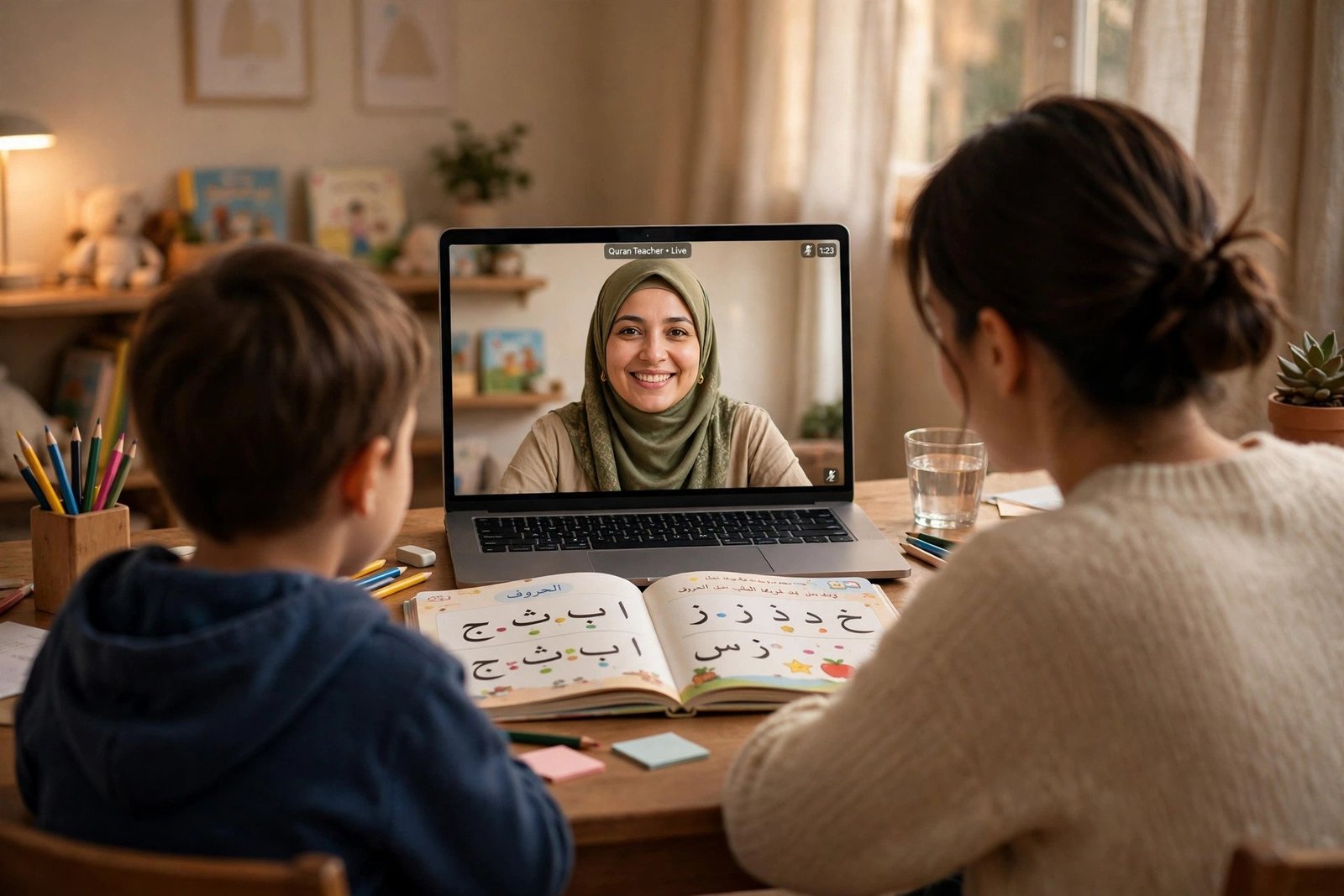
Reading the Quran yourself starts with Qaida, and Qaida has a number you can plan around. The book has 17 lessons in most editions, and each lesson needs 2 to 4 classes for a child of 7 or 8. That gives 34 to 68 classes in total. Divide that by classes per week, and the months follow.
| Classes per week | Classes per month | Classes needed | Months to finish Qaida |
|---|---|---|---|
| 2 | 8 | 34 to 68 | 4 to 9 months |
| 3 | 12 | 34 to 68 | 3 to 6 months |
| 4 | 16 | 34 to 68 | 2 to 5 months |
The table uses 4 weeks per month. A month with a holiday stretches the finish date by that week, and the teacher refines the estimate after the first few weeks, once they have heard your child read.
Cost follows the same math, using the live pricing checked on 2026-11-14. The Starter plan is $43 a month for 2 classes a week, 8 lessons a month. The Standard plan is $55 a month for 3 classes a week, 12 lessons a month. The Intensive plan is $75 a month for 4 classes a week, 16 lessons a month.
| Plan | Classes per week | Monthly price | Months to finish Qaida | Total cost to finish |
|---|---|---|---|---|
| Starter | 2 | $43 | 4 to 9 months | $183 to $366 |
| Standard | 3 | $55 | 3 to 6 months | $154 to $314 |
| Intensive | 4 | $75 | 2 to 5 months | $158 to $323 |
Cost per class is $5.38 on Starter, $4.58 on Standard, and $4.69 on Intensive. The totals are close because a faster plan costs more per month and runs for fewer months. The real choice is about pace, not about total spend.
After Qaida, the Quran Reading course has no fixed finish date in the site materials. It uses weekly reading portions and a monthly report, so the teacher sets the pace after the trial. The Quran with Tajweed course follows reading fluency, with 40-minute lessons, 3 to 5 days a week.
3 Mistakes That Cause Confusion About the Holy Books
Mistake 1 is treating the Injil as the modern Bible. The Injil, in Islamic belief, is a book revealed to Isa. The New Testament is a set of books written about Jesus, in Greek, compiled later. Mixing the 2 up makes every later discussion about the books confusing. The fix is 1 sentence: the Injil was revealed to Isa, the New Testament was written about him.
Mistake 2 is treating the 104 number as settled fact. It comes from a narration with no reliable chain. A child who learns “104 books” as a fact will repeat it, and then find a source that says the number is not known. The fix is to teach general belief first: Allah sent books, the Quran names 5, and no specific total is required.
Mistake 3 is reading only summaries and skipping the Quran itself. Summaries explain the belief in 10 minutes. They do not teach you to read the book. A child who knows the 5 names but cannot read 1 short surah has learned the list, not the book. The fix is to start the letters in Week 4 of the plan above, with a teacher who corrects pronunciation live.
Frequently Asked Questions: 6 Answers About the Holy Books in Islam
How many holy books are there in Islam?
The Quran names 5 books: the Suhuf, Tawrat, Zabur, Injil, and Quran. Some lists give 4 main books and count the Suhuf separately. Muslims also believe in general in books Allah sent that are not named.
Do Muslims believe in the Bible?
Muslims believe in the Injil, a book revealed to Isa. They do not mean the modern Bible as a whole, which is a set of books written about Jesus and others. The Quran is the book Muslims follow today.
Do Muslims believe in the Torah?
Yes, Muslims believe in the Tawrat, given to Musa, as originally revealed by Allah. They believe its original message was guidance and a light, and that it was changed over time. The Quran is the final book.
Is the Quran the only holy book Muslims follow today?
Yes, in practice. Muslims believe in all the books, but they read, recite, and follow the Quran. It is believed to be preserved in its original Arabic form, and it confirms what came before it.
What is the first holy book in Islam?
The earliest named book is the Suhuf of Ibrahim, the Scrolls given to Ibrahim. It is believed to be lost, with no complete copy known today. The Tawrat came later, given to Musa.
Can a child learn about the holy books before reading Arabic?
Yes. A child can learn the 5 names, the 5 prophets, and what each book is in 4 weeks, in 10 minutes a day. Reading Arabic starts separately, with Noorani Qaida, and a teacher can start that in the same month.
Book a Free Trial Class and Learn the Quran in Its Own Words
Knowing the 5 books is the first step. Reading the final book yourself is the next step. A free trial class gives you both: a teacher explains the belief in plain words, and then assesses your reading level in the same lesson.
Book a free trial class with a certified male or female teacher. It takes less than 24 hours from your first message to your first lesson, and no card details are required. Here is what happens in the trial, in 3 steps.
- Send your name, country, preferred timing, and course. The institute confirms your slot within a few hours by WhatsApp or email.
- Meet your teacher in a free assessment lesson, with a level check and a written study plan.
- Start live 1-on-1 lessons on Zoom, Google Meet, or Skype, at the pace that fits your week.
Bring the 4-week plan above to the trial, and ask the teacher which book and which course your child starts with.
Related Guides: Noorani Qaida Course | Quran Reading Course | Quran with Tajweed Course | Book a Free Trial Class