If you’re wondering how long the Quran is, the answer depends on how you measure it.
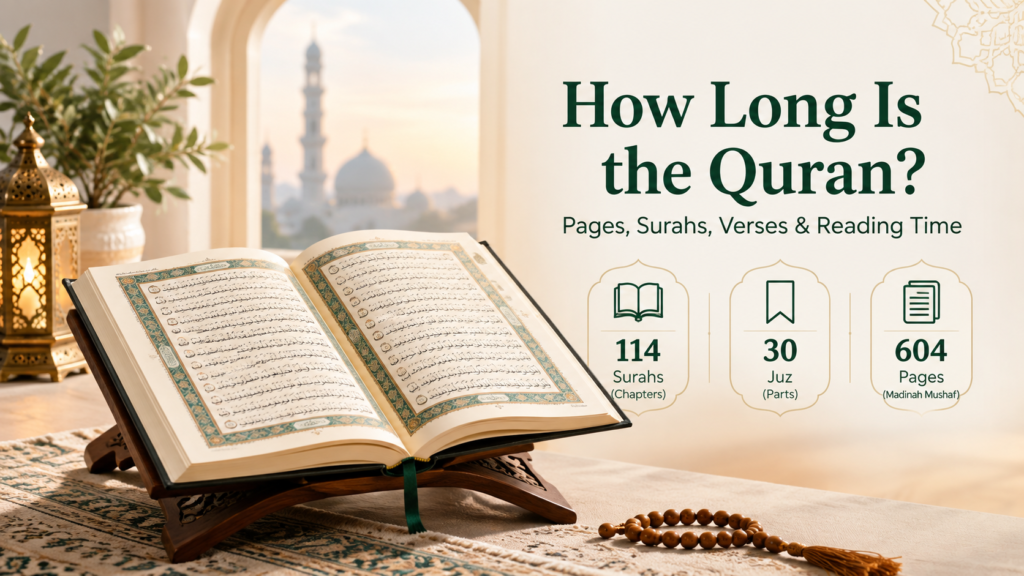
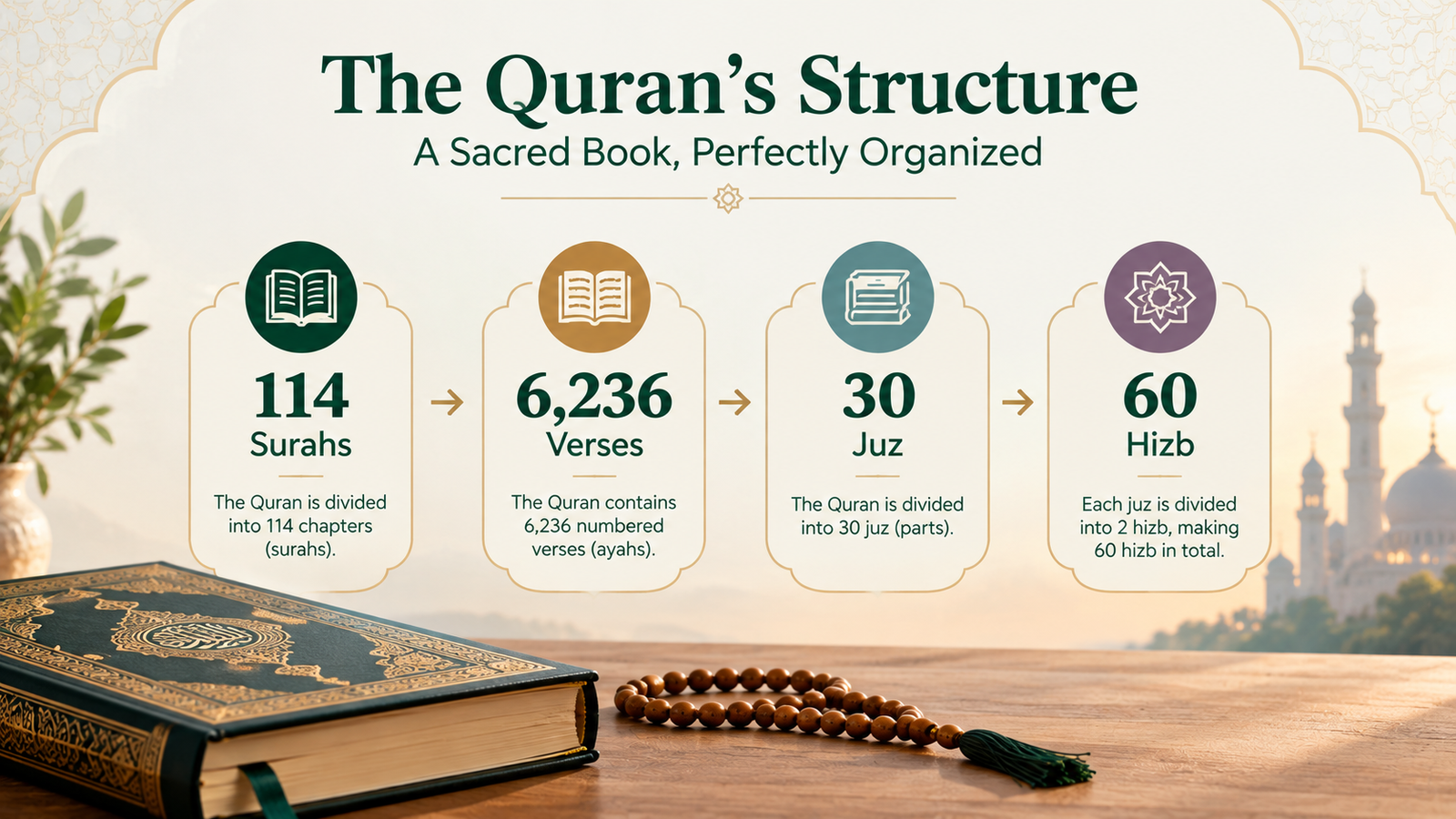
The Quran has 114 surahs (chapters) and 6,236 numbered verses in the Uthmani text. It is divided into 30 juz and 60 hizb. A commonly used 15-line Madinah Mushaf contains 604 pages, although page numbers can differ between printed editions because of differences in layout and formatting.
If your question is about reading time, that is different again. Your total reading time depends on your Arabic reading ability, pace, whether you recite with tajweed, and whether you stop to study a translation or tafsir.
Table of Contents
- How Long Is the Quran? Quick Answer
- How Many Pages Are in the Quran?
- How Many Surahs Are in the Quran?
- How Many Verses Are in the Quran?
- How Many Words and Letters Are in the Quran?
- How Many Juz Are in the Quran?
- How Long Does It Take to Read the Quran?
- How Long Does It Take to Read the Quran With Translation?
- How Long Is the Quran Compared With the Bible?
- A Simple Quran Reading Plan
- Frequently Asked Questions
- Conclusion
How Long Is the Quran? Quick Answer
Here is the simplest way to understand the length of the Quran:
| Measure | Approximate figure |
|---|---|
| Surahs (chapters) | 114 |
| Numbered verses | 6,236 |
| Juz (parts) | 30 |
| Hizb | 60 |
| Standard Madinah Mushaf | 604 pages |
| Language | Arabic |
The Quranic Arabic Corpus documents the Quran as 114 chapters containing 6,236 verses in the Uthmani script. Quran Foundation documentation similarly identifies 114 chapters, 6,236 canonical Uthmani verses, 30 juz and 60 hizb.
So, if someone asks, “How long is the Quran?”, a useful short answer is:
The Quran has 114 surahs, 6,236 numbered verses, 30 juz, and is commonly printed in a 604-page Madinah Mushaf.
How Many Pages Are in the Quran?
The commonly used 15-line Madinah Mushaf contains 604 pages.
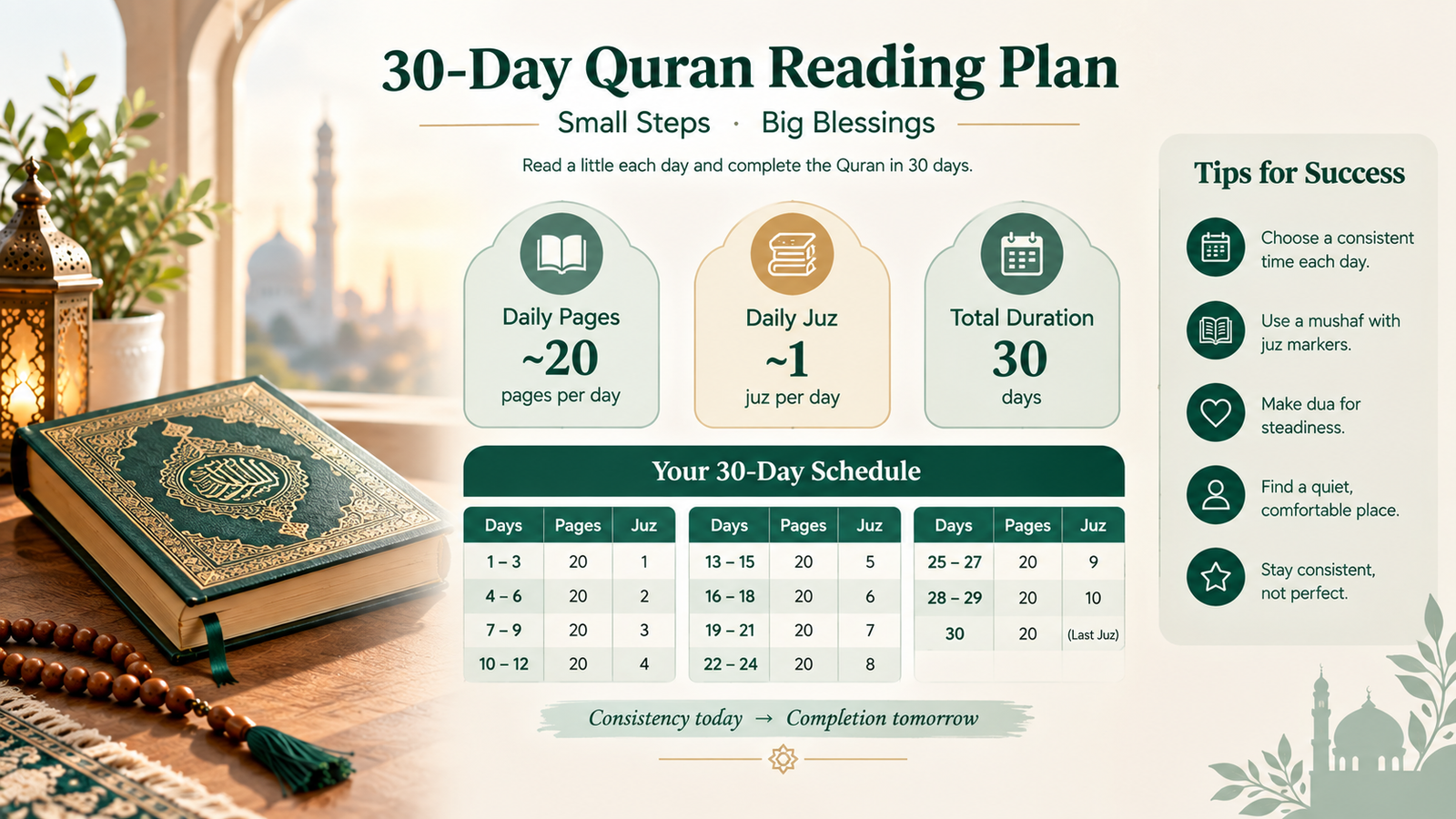
This is the page count many readers have in mind when they talk about completing the Quran in one month. With 30 juz across 604 pages, a daily reading target of roughly 20 pages provides a practical monthly schedule.
However, not every printed Quran has 604 pages.
Why the standard Quran has 604 pages
A page count describes a particular physical layout, not the amount of revelation contained in the Quran.
The number of pages can change according to:
- page size
- font size
- Arabic script and typography
- number of lines per page
- margins
- publisher
- whether translation is included
- whether commentary or notes are included
Therefore, two printed Qurans can contain the same Arabic Quranic text while having different numbers of pages.
What about Indo-Pak and other layouts?
Qurans printed using different regional layouts can have different pagination.
This is especially important if you’re creating a reading schedule. Instead of assuming every Quran has the same page numbers, check the edition you actually use.
If your Quran has 604 pages, a simple 30-day schedule is approximately 20 pages per day. If your copy has a different page count, use its juz divisions instead.
How Many Surahs Are in the Quran?
The Quran contains 114 surahs, also called chapters.
Each surah has its own name and number. The surahs vary greatly in length.
For example, Surah Al-Baqarah, the second surah, contains 286 numbered verses and is the longest surah by verse count. Short surahs near the end of the Quran can contain only a few verses.
The Quranic Arabic Corpus identifies the Quran as being organized into 114 chapters, each containing a sequence of numbered verses.
The 114 chapters of the Quran
The 114 surahs are arranged in the standard Mushaf from:
- Al-Fatihah
- Al-Baqarah
- Aal-E-Imran
- An-Nisa
- Al-Ma’idah
…through to:
- An-Nas
The order of the surahs in the Mushaf is not simply a chronological order based on when each revelation occurred.
How Many Verses Are in the Quran?
The commonly referenced Uthmani verse count is 6,236 numbered verses.
The Quranic Arabic Corpus explicitly documents 6,236 verses in its Uthmani text.
Why do some sources give different verse counts?
You may encounter other numbers when researching the total number of Quranic verses.
This does not mean that different Qurans contain different revelations.
The difference comes from traditional systems of verse counting and where a verse boundary is placed. A passage that is treated as one verse in one counting tradition may be divided differently in another.
For this reason, it is better to state the counting convention when giving an exact verse total.
For modern readers using a standard Uthmani Mushaf, 6,236 numbered verses is a clear and useful reference.
How Many Words and Letters Are in the Quran?
You will often see estimates of approximately 77,000 to 78,000 Arabic words and more than 300,000 letters when discussing the Quran’s linguistic length.
These figures should be treated as approximate rather than as a single universally agreed total.
Why do word counts vary?
Arabic word counting can be more complicated than counting English words separated by spaces.
Arabic contains attached particles and grammatical elements that can form part of the same written token. The Quranic Arabic Corpus explains that an orthographic token is separated by spaces and can contain a word together with attached elements.
As a result, different counting methods can produce different totals.
The same principle applies to letter counts: the result can depend on exactly what is counted and which representation of the Arabic text is being used.
For SEO and general readers, it is safer to say “about 77,000–78,000 words” than to present one approximate number as if there were no counting differences.
How Many Juz Are in the Quran?
The Quran is divided into 30 juz, also called parts.
The division into juz makes it easier to organize regular Quran reading.
Each juz is further divided into two hizb, giving a total of 60 hizb. The Quranic Arabic Corpus documents this structure directly.
30 juz and 60 hizb
A reader can use these divisions to create a reading schedule.
For example:
- 1 juz per day → approximately 30 days
- 1/2 juz per day → approximately 60 days
- 1/3 juz per day → approximately 90 days
These are planning targets rather than requirements. The right pace depends on the reader’s circumstances and purpose.
How Long Does It Take to Read the Quran?
There is no single reading time that applies to everyone.
Someone who reads Arabic fluently may move through the Quran much faster than someone learning Arabic letters. Reading with careful tajweed, repeating passages, or pausing for reflection also increases the total time.
A practical way to estimate your own reading time is to measure how long it takes you to read a few pages at your normal pace.
For example, if you can comfortably read 10 pages in 30 minutes, then 20 pages would take about one hour. At that pace, a 604-page Mushaf would require roughly 30 hours of reading time.
Your actual time may be higher or lower.
Reading the Quran in one month
A 30-day khatam plan is commonly based on reading approximately one juz per day.
With a 604-page Mushaf, this works out to around:
604 ÷ 30 ≈ 20 pages per day
You can divide those pages into smaller sessions instead of reading them all at once.
For example:
- After Fajr: 4 pages
- After Dhuhr: 4 pages
- After Asr: 4 pages
- After Maghrib: 4 pages
- After Isha: 4 pages
That gives approximately 20 pages a day.
Reading the Quran in two months
For a 60-day goal, divide your daily target approximately in half.
A 604-page Mushaf would require around:
604 ÷ 60 ≈ 10 pages per day
This can be useful for readers who have less available time each day.
Reading the Quran in one year
A one-year plan requires much less daily reading.
Using a 604-page Mushaf:
604 ÷ 365 ≈ 1.7 pages per day
You could therefore set a practical target of two pages per day and adjust for days when you have more or less time.
The most important part of a long-term reading plan is consistency.
Why reading speed varies
Your Quran reading time can change because of:
- familiarity with Arabic
- reading fluency
- tajweed
- pronunciation practice
- pauses
- repetition
- reflection
- translation
- tafsir or additional study
Reading the Arabic text aloud is therefore different from reading an English translation silently, and neither should be assumed to take the same amount of time.
How Long Does It Take to Read the Quran With Translation?
Reading the Quran together with a translation generally takes longer than reading the Arabic text alone.
That is because you are performing two activities:
- Reciting or reading the Arabic.
- Reading and considering the translated meaning.
If you also consult tafsir, footnotes, explanations, or related references, your study session can take considerably longer.
There is no single correct pace for studying the Quran. Someone reading for completion may use a different pace from someone studying a small number of verses in depth.
How Long Is the Quran Compared With the Bible?
Comparing the Quran and Bible by page count can be misleading because editions vary significantly.
A Quran printed in Arabic, a Quran with an English translation, a study Quran with notes, and different editions of the Bible can all have substantially different page layouts.
Word count can also vary depending on which translation or textual edition is being compared.
For that reason, a page-for-page comparison does not provide a reliable measure of the relative length of the underlying texts.
If you’re comparing the two scriptures for study purposes, it is better to identify the specific editions or translations being compared.
A Simple Quran Reading Plan
You do not have to choose a one-month schedule.
Here are three simple options based on a 604-page Mushaf:
30-day plan
Goal: approximately 20 pages per day.
This is approximately one juz each day.
60-day plan
Goal: approximately 10 pages per day.
This gives you more time for pronunciation, translation, and reflection.
90-day plan
Goal: approximately 7 pages per day.
This is a manageable option for readers who want a slower, steady routine.
If your Quran has a different page count, use the 30-juz structure or calculate the daily pages based on the number of pages in your own edition.
Frequently Asked Questions
How long is the Quran?
The Quran contains 114 surahs and 6,236 numbered verses in the Uthmani text. A commonly used Madinah Mushaf contains 604 pages and the Quran is divided into 30 juz.
How many pages are in the Quran?
A standard 15-line Madinah Mushaf is commonly printed with 604 pages. Other editions can have different page counts because of their layout, script, font, and formatting.
How many chapters are in the Quran?
There are 114 chapters, known as surahs.
How many verses are in the Quran?
The Uthmani text contains 6,236 numbered verses. Different traditional systems of verse counting can produce different totals because of differences in verse boundaries.
How many juz are in the Quran?
There are 30 juz. Each juz is divided into two hizb, making 60 hizb in total.
How long does it take to read the whole Quran?
The answer depends on your reading speed, Arabic fluency, tajweed, pauses, and whether you are also studying translation or tafsir. A useful way to estimate your personal reading time is to time yourself reading several pages and use that pace to estimate the full Mushaf.
Can I finish the Quran in 30 days?
Yes. A common approach is to read approximately one juz each day. With a 604-page Mushaf, this works out to about 20 pages per day.
How many words are in the Quran?
Common estimates put the Quran at approximately 77,000–78,000 Arabic words. Exact totals can vary depending on the counting method used.
Does every Quran have 604 pages?
No. The 604-page figure refers to a commonly used Madinah Mushaf layout. Different editions can contain more or fewer pages while presenting the same Quranic text.
Is the Quran longer when translated into English?
An English translation can occupy considerably more pages because translation, typography, notes, introductions, and commentary add material. The page count therefore depends on the specific edition.
Conclusion
So, how long is the Quran?
The answer depends on what you mean by “long.”
The Quran has:
- 114 surahs
- 6,236 numbered verses in the Uthmani text
- 30 juz
- 60 hizb
- About 604 pages in a commonly used Madinah Mushaf
The physical page count can vary between editions, while word and letter counts can vary according to counting conventions.
If your goal is to read the entire Quran, you don’t need to finish it as quickly as possible. A consistent schedule—whether 30, 60, 90 days, or longer—can make the goal easier to manage.
Ready to start? Choose a daily Quran reading target with quranonlineinstitute.com that fits your schedule, begin with a manageable portion, and build consistency one day at a time.