What is haram in Islam? Haram refers to anything that Allah has clearly forbidden in Islamic teachings, whether it involves food, drink, money, relationships, speech, or personal behaviour. Muslims are required to avoid what is haram, while following Allah’s guidance helps them live with faith, honesty, and responsibility.
Understanding the meaning of haram is an essential part of learning Islam. It helps Muslims distinguish between what is permitted (halal), what is forbidden (haram), and what is simply discouraged.
But there is more to this subject than memorising a list of forbidden things. Muslims also need to understand where Islamic rulings come from and why declaring something haram without proper evidence is a serious matter.
Let’s explore the meaning of haram, common examples, and how to recognise prohibited actions in everyday life.
What Does Haram Mean in Islam?
The Arabic word haram (حرام) means forbidden, prohibited, or unlawful. In Islamic terminology, it describes something that Allah and His Messenger ﷺ have prohibited through the Quran and authentic Sunnah.
A Muslim who deliberately commits an established haram act without a valid excuse commits a sin. Avoiding it in obedience to Allah is an act of worship and earns reward.
Haram is the opposite of halal (حلال), which means permissible or lawful.
For example:
- Eating pork is haram.
- Drinking intoxicating alcohol is haram.
- Speaking truthfully is permissible and encouraged.
- Giving charity is a good deed rewarded by Allah.
The distinction is not simply about personal preferences. Islamic rulings have religious foundations, and Muslims should take care not to confuse personal opinions with Allah’s commands.
How Does Islam Determine What Is Haram?
Islam does not leave the definition of haram to individual preferences, family traditions, or popular opinion.
The primary sources of Islamic guidance are:
1. The Holy Quran
The Quran contains direct commands and prohibitions from Allah. It identifies various forbidden foods, practices, and behaviours.
For example, Surah Al-Baqarah (2:173) prohibits consuming carrion, blood, pork, and animals dedicated to someone other than Allah, while also mentioning an exception for genuine necessity.
2. The Sunnah of Prophet Muhammad ﷺ
The Sunnah explains and expands upon Quranic teachings through the Prophet’s sayings, actions, and approvals.
Authentic Hadith provide guidance on matters that Muslims encounter in their daily lives. Scholars use the Quran and Sunnah together when explaining Islamic rulings.
3. Islamic scholarship and Fiqh
Qualified Islamic scholars study religious evidence and apply established principles of Islamic jurisprudence (Fiqh).
This becomes particularly important when Muslims encounter modern questions that are not addressed by a simple, direct statement in the Quran.
A useful warning appears in Surah An-Nahl (16:116). Allah warns against falsely declaring something lawful or unlawful and attributing that declaration to Him.
The lesson is straightforward: do not label something haram simply because you dislike it or because someone in your community says so.

What Are Common Examples of Haram in Islam?
Haram is not limited to food. Islamic prohibitions concern a Muslim’s relationship with Allah, treatment of other people, financial dealings, and personal conduct.
Here are important examples supported by Islamic teachings.
1. Eating Forbidden Foods
Food is one of the first areas people associate with the word haram.
The Quran identifies several prohibited foods in Surah Al-Baqarah (2:173), including:
- Pork and its meat.
- Blood.
- Carrion (animals that have died without the required lawful slaughter).
- Animals dedicated to someone other than Allah.
Muslims must also pay attention to how meat is sourced and prepared according to applicable Islamic requirements.
However, there is an important qualification. The same Quranic verse recognises genuine necessity as an exception, provided a person does not seek the forbidden food out of desire or exceed what necessity requires.
This shows that Islamic rulings must be understood in their proper context rather than reduced to slogans.
2. Drinking Alcohol and Using Intoxicants
Islam prohibits intoxicants because they impair judgement and can lead to harmful behaviour.
In Surah Al-Ma’idah (5:90), Allah instructs believers to avoid intoxicants and gambling.
The prohibition is not limited to drinking during Ramadan. It applies throughout the year.
Muslims should also understand that the discussion of intoxicants concerns substances that cause intoxication, not simply a particular beverage or occasion.
3. Gambling and Unlawful Financial Practices
Gambling is another established prohibition in Islam.
It involves risking money or property on uncertain outcomes in a manner that falls under prohibited gambling.
Surah Al-Ma’idah (5:90–91) discusses gambling alongside intoxicants and describes their harmful effects.
Islam also prohibits unjustly taking another person’s wealth.
Surah An-Nisa (4:29) instructs believers not to consume one another’s wealth unlawfully and emphasises trade based on mutual consent.
Examples of dishonest financial conduct include:
- Stealing money or property.
- Fraud and deliberate deception.
- Cheating customers in business.
- Taking another person’s property without permission.
Riba (interest or usury) is also prohibited in Islamic teachings. Surah Al-Baqarah (2:275) explicitly addresses riba.
Modern financial products sometimes require careful examination, so Muslims should seek qualified advice rather than assume every financial arrangement has the same ruling.
4. Lying, Backbiting, and Slandering Others
A person’s words matter in Islam.
Lying, spreading damaging false information, and backbiting are serious matters because they harm other people and damage relationships.
Surah Al-Hujurat (49:12) specifically warns believers against spying and backbiting.
Backbiting (Gheebah) means speaking about another person in their absence in a way they would dislike, even when what is said is true.
Slander involves making false accusations or spreading untrue information about someone.
For example, sharing a private rumour about a colleague or neighbour to damage their reputation is not harmless conversation.
Muslims should be careful with their words, including messages, online comments, and social media posts.
5. Zina and Unlawful Sexual Relationships
Islam places great importance on modesty, chastity, and protecting family relationships.
Zina refers to unlawful sexual relations outside a valid Islamic marriage.
In Surah Al-Isra (17:32), Allah instructs believers not even to approach zina, describing it as an immoral act and an evil path.
This instruction also encourages Muslims to avoid circumstances and behaviour that lead towards sexual wrongdoing.
Modesty is therefore not just about clothing. It also involves speech, intentions, boundaries, and behaviour.
[INTERNAL LINK: Importance of Modesty in Islam]
6. Disobedience and Mistreatment of Parents
Islam gives parents a significant position of respect.
Surah Al-Isra (17:23) instructs Muslims to worship Allah alone and treat their parents with kindness.
Deliberately mistreating parents, insulting them, or causing them unnecessary harm is a serious sin.
However, respect does not mean obeying every parental instruction regardless of its content. A Muslim must not obey anyone in disobedience to Allah.
The proper approach is to maintain kindness and respect while remaining committed to Islamic principles.
7. Theft, Injustice, and Harming Others
Islam prohibits violating the rights of other people.
Taking someone’s property, cheating a person, spreading false accusations, or deliberately causing harm are examples of wrongdoing.
The Quran repeatedly emphasises justice, honesty, and respect for human dignity.
A person cannot justify dishonest behaviour simply by claiming to be religious in other areas of life.
Worship and good character belong together.
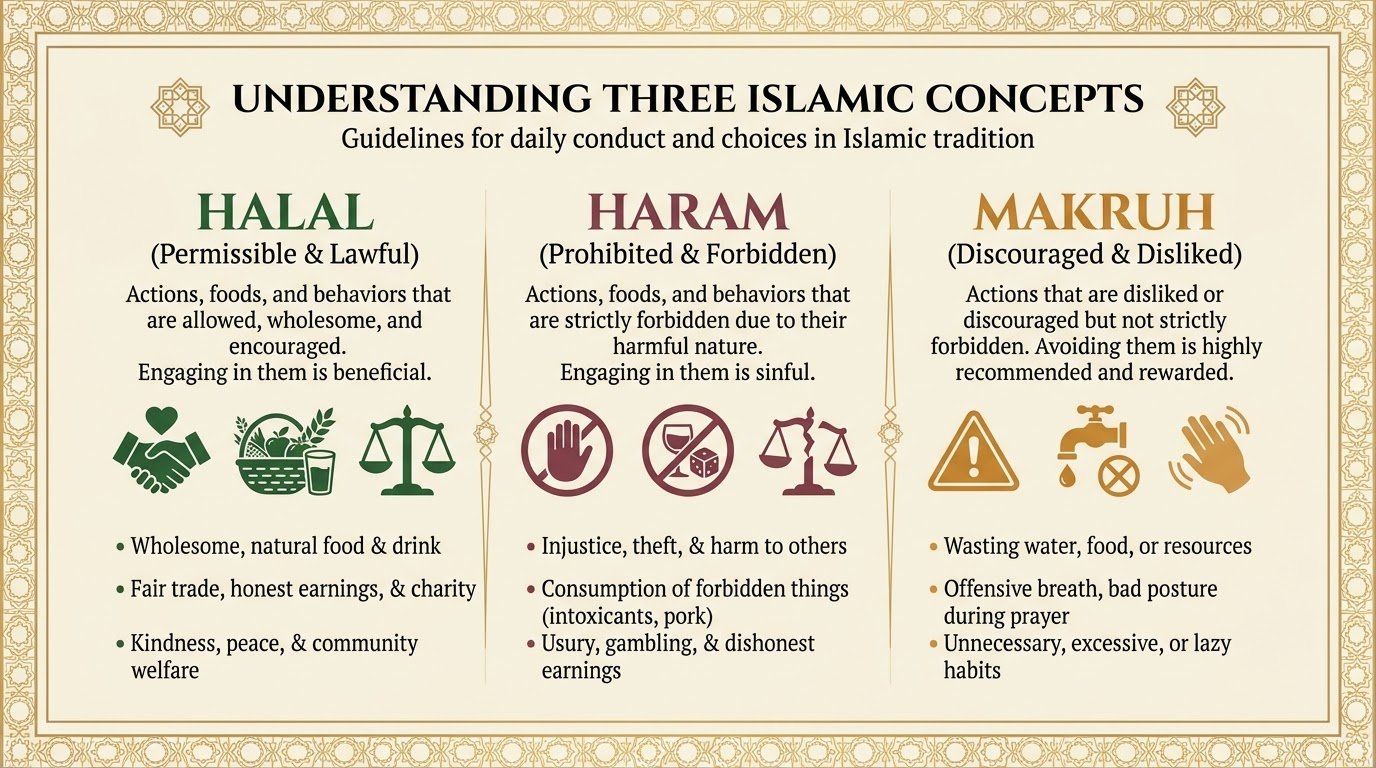
What Is the Difference Between Haram, Halal, and Makruh?
These three terms describe different Islamic rulings. Understanding the difference prevents unnecessary confusion.
| Term | Meaning | General ruling |
|---|---|---|
| Halal | Permissible | Allowed in Islam |
| Haram | Forbidden | Must be avoided |
| Makruh | Disliked or discouraged | Avoiding it is encouraged, but it is not the same as a definitive prohibition |
Haram and makruh are not interchangeable.
For example, if an action is established as haram, deliberately performing it is sinful. A makruh action, in the technical sense, is discouraged but does not carry the same ruling as haram.
Islamic jurisprudence also recognises other categories, including:
- Fard or Wajib: Obligatory actions.
- Mustahabb: Recommended actions.
- Mubah: Permissible actions.
These classifications help Muslims understand that not every action is simply halal or haram.
Are Doubtful Things Also Haram?
No. Something being doubtful does not automatically mean it is haram.
Islam recognises that some matters are clear, while others require further investigation and scholarly understanding.
In Sahih al-Bukhari 52, Prophet Muhammad ﷺ explained that halal and haram are clear, but doubtful matters exist between them. He encouraged believers to avoid doubtful matters to protect their religion and honour.
This Hadith offers practical guidance.
Suppose a Muslim encounters a financial product, food ingredient, or business arrangement whose religious status is unclear. Rather than making an unsupported decision, the person should investigate the details and ask a qualified scholar.
Avoiding doubtful matters is a form of caution. It should not become an excuse to declare everything unfamiliar forbidden.
Are Things Haram Because of Culture or Personal Opinions?
Not necessarily.
A practice can be unfamiliar, unpopular, or discouraged by a particular family without being prohibited by Islamic law.
For example, a family might have a tradition against a particular type of clothing, food, or social activity. That tradition alone does not establish a religious prohibition.
The reverse is also true. Something widely accepted in a community does not automatically become halal.
The Quran’s warning in Surah An-Nahl (16:116) is especially relevant here: Muslims must not attribute unsupported halal and haram rulings to Allah.
When Muslims disagree about a matter, it is better to examine the evidence and understand the scholarly reasoning than to accuse one another of wrongdoing.
What Should You Do If You Have Done Something Haram?
Islam does not teach that a person who has committed a sin should give up hope.
Allah’s mercy and the opportunity to repent are central to Islamic teaching.
A Muslim who recognises a mistake should take the following steps:
1. Stop the sinful action.
Do not knowingly continue an established prohibited act.
2. Feel genuine regret.
Recognise the mistake and sincerely regret disobeying Allah.
3. Ask Allah for forgiveness.
Make sincere Tawbah and ask Allah to forgive the sin.
4. Make a sincere intention not to repeat it.
Repentance involves a genuine commitment to leave the wrongdoing.
5. Restore other people’s rights where necessary.
If the wrongdoing involved stealing money, damaging someone’s property, or violating another person’s rights, take appropriate steps to make things right.
Do not let past mistakes become a reason to abandon prayer, Quran recitation, or other good deeds.

How Can Muslims Avoid Haram in Everyday Life?
Avoiding haram starts with learning. Muslims do not need to become Islamic scholars before making responsible everyday decisions, but they should develop the habit of seeking reliable guidance.
A practical approach includes:
- Learn the basic halal and haram rulings from the Quran and authentic Sunnah.
- Check food ingredients and sources when there is a genuine reason for concern.
- Earn and spend money honestly.
- Avoid gossip, lies, and harmful speech.
- Maintain appropriate boundaries in relationships.
- Ask qualified scholars about complicated or disputed matters.
- Teach children Islamic values through understanding and good example.
Parents can also make Quran and Islamic studies part of their children’s regular learning. Understanding Allah’s guidance from an early age helps children develop a sense of responsibility rather than simply memorising rules.
Benefits of Learning Quran for Children
Frequently Asked Questions About Haram in Islam
What does haram mean in simple words?
Haram means forbidden or prohibited according to Islamic teachings. Muslims are required to avoid actions and things that Allah has prohibited.
What are five examples of haram in Islam?
Five examples are eating pork, drinking intoxicants, gambling, stealing, and backbiting. These prohibitions are supported by Quranic teachings.
Is everything that is bad automatically haram?
No. Something being unpleasant, unpopular, or discouraged does not automatically make it haram. A religious prohibition requires proper Islamic evidence and interpretation.
Is haram worse than makruh?
Haram is a definitive prohibition, whereas makruh is generally discouraged but is not equivalent to haram. Deliberately committing an established haram act is sinful.
Can something become halal after being haram?
The general ruling remains established unless there is a recognised Islamic basis for a different ruling or an applicable exception. For example, Surah Al-Baqarah (2:173) recognises necessity as an exception concerning certain prohibited foods.
Who decides what is halal and haram?
Allah is the ultimate Lawgiver. Islamic rulings are derived from the Quran and Sunnah, with qualified scholars interpreting and applying the evidence through Islamic jurisprudence.
Final Thoughts
Understanding what is haram in Islam is part of building a meaningful relationship with Allah and following His guidance in everyday life.
The most helpful starting point is to learn the clear prohibitions, understand their Quranic and Sunnah foundations, and avoid making religious judgments without evidence.
If you are unsure about a particular action, food, or financial matter, consult a knowledgeable and trustworthy Islamic scholar.
Keep learning, practise what you understand, and make the Quran a regular part of your life. Knowledge should lead to better decisions, sincere worship, and improved character.