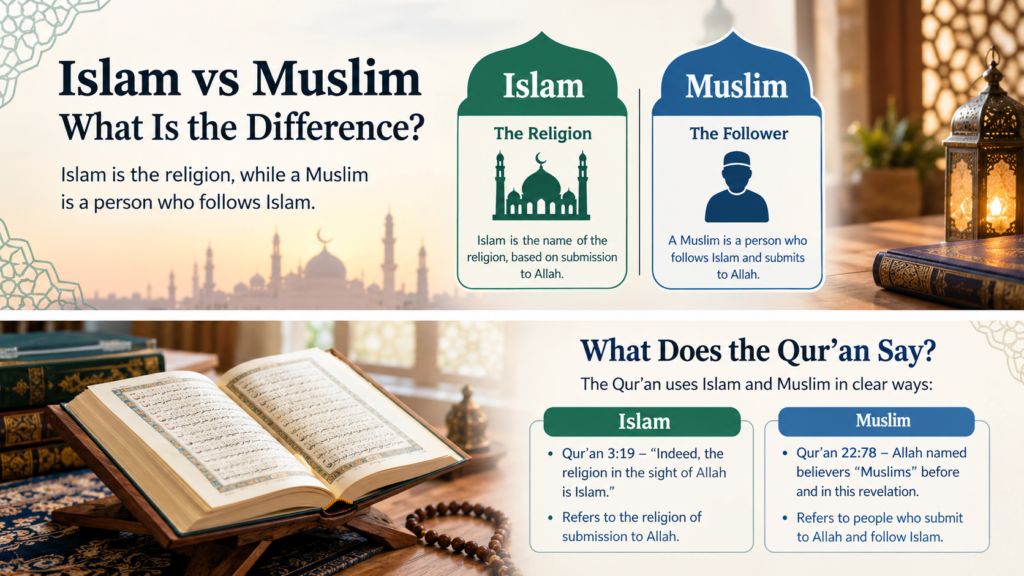
Islam and Muslim are related, but they do not mean the same thing. Islam is the name of the religion, while a Muslim is a person who follows Islam. The Qur’an itself uses the word Islam for the religion and the word Muslim for people who submit to Allah. Understanding that distinction also helps explain related words such as Islamic and Mu’min.
English dictionaries make essentially the same distinction: Muslim refers to a person who follows Islam, while Islam refers to the religion. [Cambridge Dictionary]
That sounds simple—and it is. The interesting part comes when you look at the Qur’an.
The Qur’an does not treat these words as random labels. It uses Islam and Muslim in ways that connect the religion with submission to Allah.
What does the word Islam refer to?
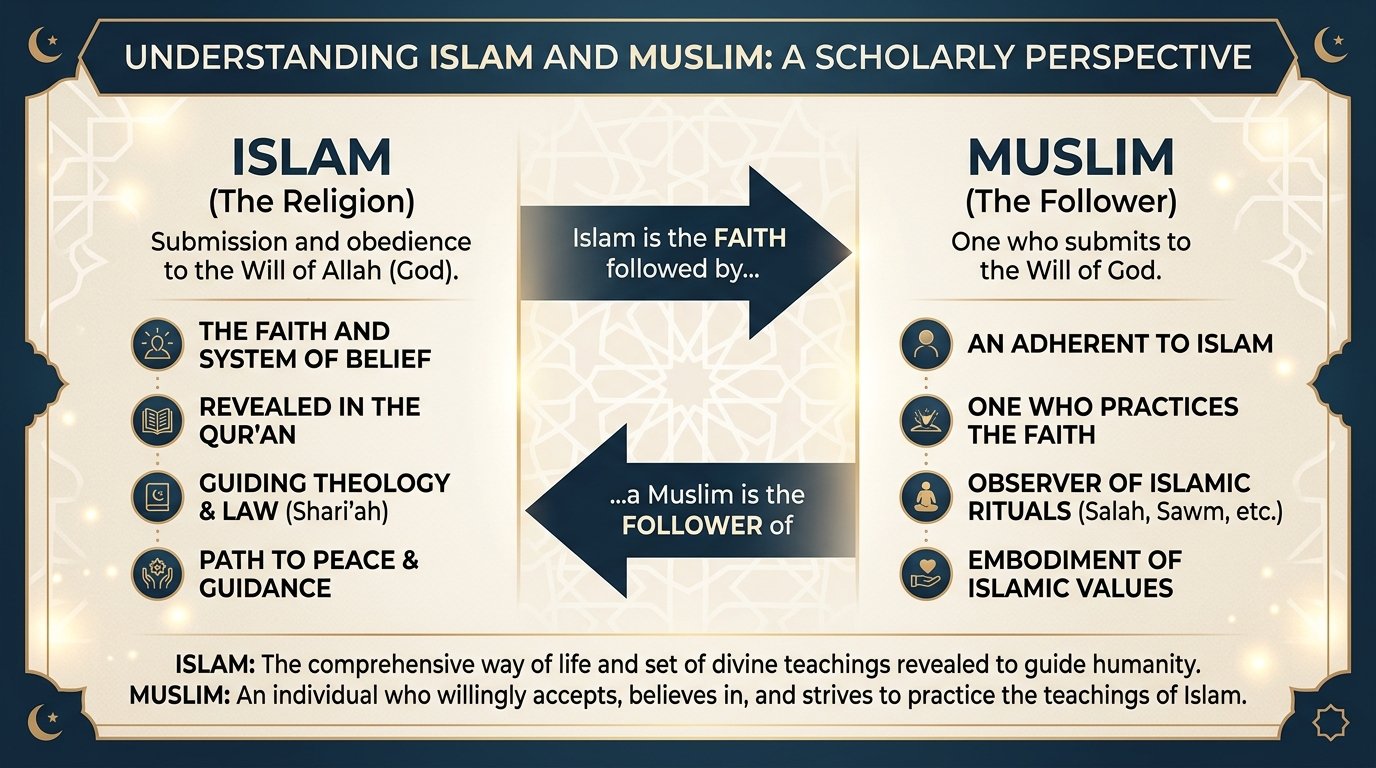
Islam is the name of the religion and, in its basic sense, refers to submission to Allah.
The Qur’an says in Surah Aal ‘Imran:
“Indeed, the religion in the sight of Allah is Islam.”
Qur’an 3:19
This is one of the clearest verses for understanding the question. The word Islam is being used as the name of the religion. [Qur’an 3:19]
Islam therefore is not the name of a particular ethnic group or nationality.
A person can be Arab, Pakistani, Nigerian, Turkish, Indonesian, American, British, or from countless other backgrounds and be Muslim. The word Islam identifies the religion, not an ethnicity.
For a beginner, this distinction is useful:
Islam = what the religion is.
Muslim = what a follower of that religion is called.
What does Muslim mean?
A Muslim is a person who submits to Allah and follows Islam.
The English word comes from the Arabic Muslim (مُسْلِم), which is connected to the same Arabic root as Islam. The basic idea is that the person is one who submits.
The Qur’an uses the word Muslim as a description for people. In Qur’an 22:78, Allah says that He named believers “Muslims” before and in the Qur’an. [Qur’an 22:78]
That detail matters.
The Qur’anic use of Muslim is not presented as a label invented for one particular modern nationality. The term is tied to submission to Allah.
So if Islam is the religion, a Muslim is the person who identifies with and follows that religion.
Think of the grammatical relationship:
Islam → religion
Muslim → follower
The relationship is similar to other familiar pairs:
Christianity → Christian
Buddhism → Buddhist
Islam → Muslim
The comparison is useful for English grammar, although Islam has its own theological meanings that go beyond a simple vocabulary comparison.
Why are Islam and Muslim connected?
They are connected because both words come from the same Arabic family of words.
The central idea is submission to Allah.
This is why the words look and sound related. They are not two unrelated terms that happen to describe the same community.
There is a practical lesson here. A Muslim is not simply someone carrying a cultural label. The word itself points toward submission.
That is also why Islamic sources frequently explain Islam through submission and obedience to Allah. For example, IslamQA describes Islam as submission to Allah, worshipping Him alone, and obeying Him.
The exact details of Arabic morphology are more technical than most beginners need. If you are learning the Qur’an, though, recognizing related Arabic words is valuable because one root can connect several words and ideas.
What does the Qur’an say about Islam?
The Qur’an directly names Islam as the religion.
Qur’an 3:19 says:
“Indeed, the religion in the sight of Allah is Islam.”
The verse is therefore a strong primary source when answering the question “Is Islam the religion?”
Yes.
The Qur’an also uses the idea of submitting to Allah in surrounding verses. In Qur’an 3:20, the Prophet ﷺ is instructed to say that he has submitted himself to Allah. [Qur’an 3:20]
This helps us see why the words Islam and Muslim belong together.
There is a religion called Islam.
There are people called Muslims who submit to Allah and follow that religion.
For anyone studying the Qur’an, this is more useful than memorizing a dictionary definition alone.
What does the Qur’an say about Muslims?
The Qur’an repeatedly uses the word Muslim for people.
One particularly clear example appears in Qur’an 22:78. The verse says that Allah named believers “Muslims” before and in this revelation. [Qur’an 22:78]
This also helps answer another common question:
“Was the word Muslim only used after Prophet Muhammad ﷺ?”
The Qur’anic answer is more nuanced. Qur’an 22:78 connects the designation with the religion of Abraham and says that Allah named them Muslims before and in the revelation.
That is why an Islamic explanation of the term should not reduce Muslim to a modern ethnic or cultural identity.
Is Islam the same as iman?
This is where a basic article can easily become confusing.
Islam and iman are closely related, but the Qur’an and Sunnah sometimes distinguish them when they appear together.
The distinction is especially clear in Qur’an 49:14.
The verse describes some Bedouins saying that they had believed. They are told instead to say that they had submitted, because faith had not yet entered their hearts. [Qur’an 49:14]
This verse is important because it shows that Islam and iman can have distinct meanings in a particular context.
Islamic scholars have explained this distinction in different ways, but a common explanation is:
- Islam can refer to outward submission and practice.
- Iman can refer particularly to inward faith and belief.
Dar al-Ifta Egypt similarly explains that the Qur’an sometimes uses Muslim and Mu’min interchangeably, while other passages give the terms more specific meanings. [Dar al-Ifta]
IslamQA also explains that when Islam and iman are mentioned together, Islam can refer to outward actions while iman refers to inward belief.
That does not mean Islam is merely outward behavior or that iman has nothing to do with actions. Islamic terminology changes with context, and the wider Qur’an and Sunnah must be considered.
For this article, the key point is simpler:
Islam, Muslim, and iman are related terms, but they are not automatically interchangeable in every Qur’anic context.
What is the difference between Muslim and Mu’min?
A Muslim is someone associated with Islam and submission to Allah.
A Mu’min is a believer—someone characterized by iman, or faith.
In everyday English, people might use “Muslim” and “believer” almost interchangeably. In Qur’anic and scholarly discussions, however, the distinction can become more precise.
Qur’an 49:14 is the key example because it explicitly discusses submission and faith separately in that context.
This is one area where a beginner should avoid oversimplifying.
You will sometimes encounter the statement:
“Every Mu’min is a Muslim, but not every Muslim is a Mu’min.”
Some Islamic scholars use this formulation when the two terms are being distinguished in a particular context. Other texts use the terms more broadly or interchangeably.
So the safest lesson is not to force one definition onto every verse.
Read the context.
What does Islamic mean?
Islamic is an adjective.
It describes something connected with Islam.
Examples include:
- Islamic studies
- Islamic history
- Islamic law
- Islamic art
- Islamic teachings
- Islamic scholarship
By contrast, Muslim normally describes a person or people:
- a Muslim student
- a Muslim family
- Muslim scholars
- Muslim communities
Cambridge Dictionary defines Islamic as something connected with the Muslim religion or with people and countries that follow it. [Cambridge Dictionary]
This gives you a useful language rule:
Use Muslim for people. Use Islamic for things connected with Islam.
So:
“a Muslim teacher” is natural.
“an Islamic teacher” can mean something different and may sound awkward if you simply mean a teacher who is Muslim.
Likewise:
“Islamic teachings” works.
“Muslim teachings” is less precise if you mean the teachings of the religion itself.
Are Islam and Muslim interchangeable in English?
No—not if you want precise language.
You might hear people say “the Muslim religion.” The intended meaning is usually obvious, but Islam is the name of the religion, while Muslim refers to its followers.
Compare:
Correct: “She converted to Islam.”
Corect: “She is Muslim.”
Correct: “She studies Islamic history.”
The words are connected, so confusion is understandable. But they perform different jobs in a sentence.
One simple trick helps:
Ask yourself, “Am I talking about the religion or a person?”
You are talking about the religion, use Islam.
If you are talking about a follower, use Muslim.
If you are describing something connected with the religion, Islamic will often be the appropriate adjective.
Why should we distinguish Islam from the actions of Muslims?
This is one of the most useful points that many short articles leave out.
A religion and the behavior of individual followers are not grammatically or conceptually identical.
A Muslim can make a mistake.
Muslim can misunderstand a teaching.
Muslim can fail to practice something he or she believes is obligatory.
That does not automatically tell you what Islam itself teaches.
This distinction is also reflected in Islamic educational writing. One Islamic source explicitly argues that Muslims’ actions should be judged against Islamic teachings rather than treating every Muslim action as a definition of Islam. [CPS Global]
The same principle works in the other direction. A person cannot claim that every personal action is automatically Islamic simply because that person is Muslim.
For someone studying the Qur’an, the better approach is straightforward:
If you want to know what Islam teaches, look at the Qur’an, authentic Sunnah, and reliable scholarship—not at one random Muslim’s behavior.
How to Read and Understand the Quran
Simple examples of Islam vs Muslim
Here are a few examples worth remembering.
Islam is a religion.
“Islam teaches Muslims to worship Allah.”
A Muslim is a person.
“My neighbor is Muslim.”
Islamic describes something related to Islam.
“She is studying Islamic history.”
Muslims is the plural.
“Muslims around the world observe Ramadan.”
The pattern is easy:
| Term | Refers to | Example |
|---|---|---|
| Islam | The religion | “I am learning about Islam.” |
| Muslim | A person | “He is Muslim.” |
| Muslims | People, plural | “Muslims pray to Allah.” |
| Islamic | Something related to Islam | “She studies Islamic history.” |
| Iman | Faith/belief, especially in contexts where it is distinguished from Islam | “The Qur’an discusses iman and Islam.” |
Common mistakes to avoid
Saying “Islam” when you mean a person
Incorrect:
“An Islam came to our class.”
Better:
“A Muslim came to our class.”
Saying “Muslim” when you mean the religion
Less precise:
“Muslim teaches belief in one God.”
Better:
“Islam teaches belief in one God.”
Treating Muslim and Islamic as exact synonyms
They overlap in some contexts, but they do different grammatical jobs.
“A Muslim family” describes the people.
“Islamic education” describes the subject or educational tradition.
Assuming every Muslim has the same culture
Islam is a religion. Muslim communities exist across many cultures and societies.
The distinction between religion and culture is especially useful when studying Islam because customs can vary while the basic religious terminology remains the same.
Assuming a simple definition answers every theological question
“Islam is the religion and Muslim is the follower” is the right starting point.
It is not the whole discussion.
Once you study Qur’an 49:14 and related passages, you encounter the more detailed relationship between Islam, iman, and being a Muslim. That is where context matters.
FAQs
Is Islam and Muslim the same?
No. Islam is the religion, while a Muslim is a person who follows Islam. The terms are closely related but refer to different things.
Is a Muslim a religion or a person?
A Muslim is a person. A Muslim is someone who follows Islam.
What is Islam in simple words?
Islam is the name of the religion based on submission to and worship of Allah. The Qur’an explicitly says, “Indeed, the religion in the sight of Allah is Islam” (Qur’an 3:19).
What does Muslim mean?
Muslim refers to a person who submits to Allah and follows Islam. The Qur’an uses the term for people and says in Qur’an 22:78 that Allah named them Muslims.
What is the difference between Muslim and Islamic?
Muslim normally describes a person, while Islamic normally describes something related to Islam.
For example, “a Muslim student” refers to a person, while “Islamic studies” refers to a field of study.
What is the difference between Islam and iman?
They are closely related. In some Qur’anic contexts, especially Qur’an 49:14, Islam and iman are distinguished, with Islam referring to submission and iman referring particularly to faith in the heart. In other contexts, the terms can overlap.
Are all Muslims Arabs?
No. Muslim is a religious identity, while Arab is an ethnic and linguistic identity. Muslims come from many different ethnic, linguistic, and cultural backgrounds.
Can Muslims make mistakes?
Yes. Muslims are human beings and can make mistakes. A person’s behavior should not automatically be treated as a definition of what Islam teaches.
Conclusion
The difference between Islam and Muslim is simple once you separate the religion from the person.
Islam is the religion. A Muslim is a person who follows Islam. Islamic describes something connected with Islam.
The Qur’an makes the relationship deeper than a dictionary definition. It names Islam as the religion in Qur’an 3:19 and calls people Muslims in Qur’an 22:78. Qur’an 49:14 also shows why the related terms Islam and iman need to be understood according to context.
So remember the basic pattern:
Islam = religion
Muslim = person
Islamic = related to Islam
Iman = faith, with its precise meaning depending on context
If you are learning Qur’an, do not stop at memorizing the English definitions. When you encounter these words in Arabic, look at the verse around them. Context often tells you more than a dictionary can.