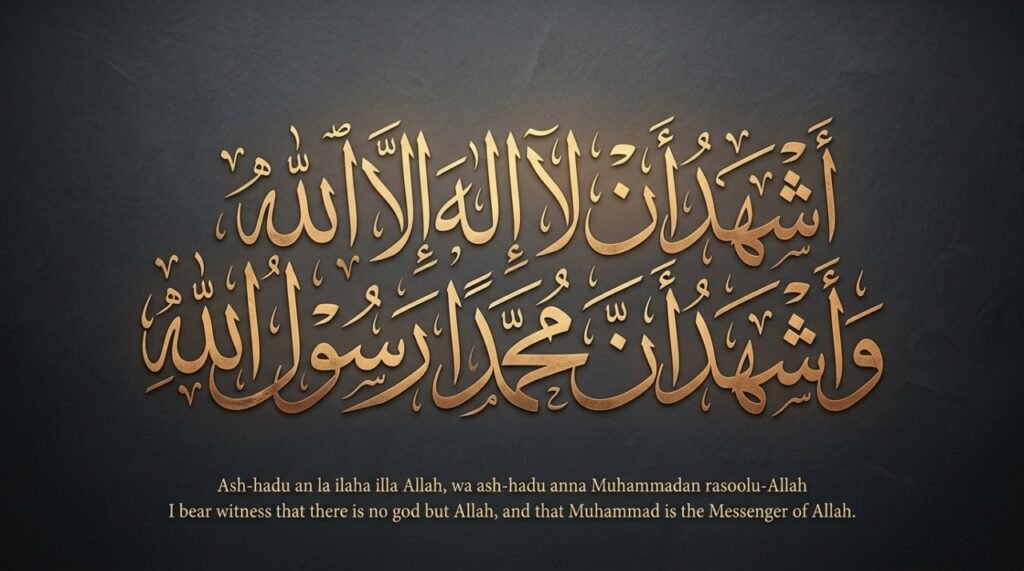
The Shahada is the Islamic declaration of faith: Ash-hadu an la ilaha illallah wa ash-hadu anna Muhammadan rasulullah — “I bear witness that there is no god but Allah, and I bear witness that Muhammad is the Messenger of Allah.” It is the first of the Five Pillars of Islam and the single statement that marks a person’s entry into the faith.
The grammar that changes everything
Most articles will hand you the translation above and move on. That’s a mistake, because the English flattens something the Arabic is doing deliberately.
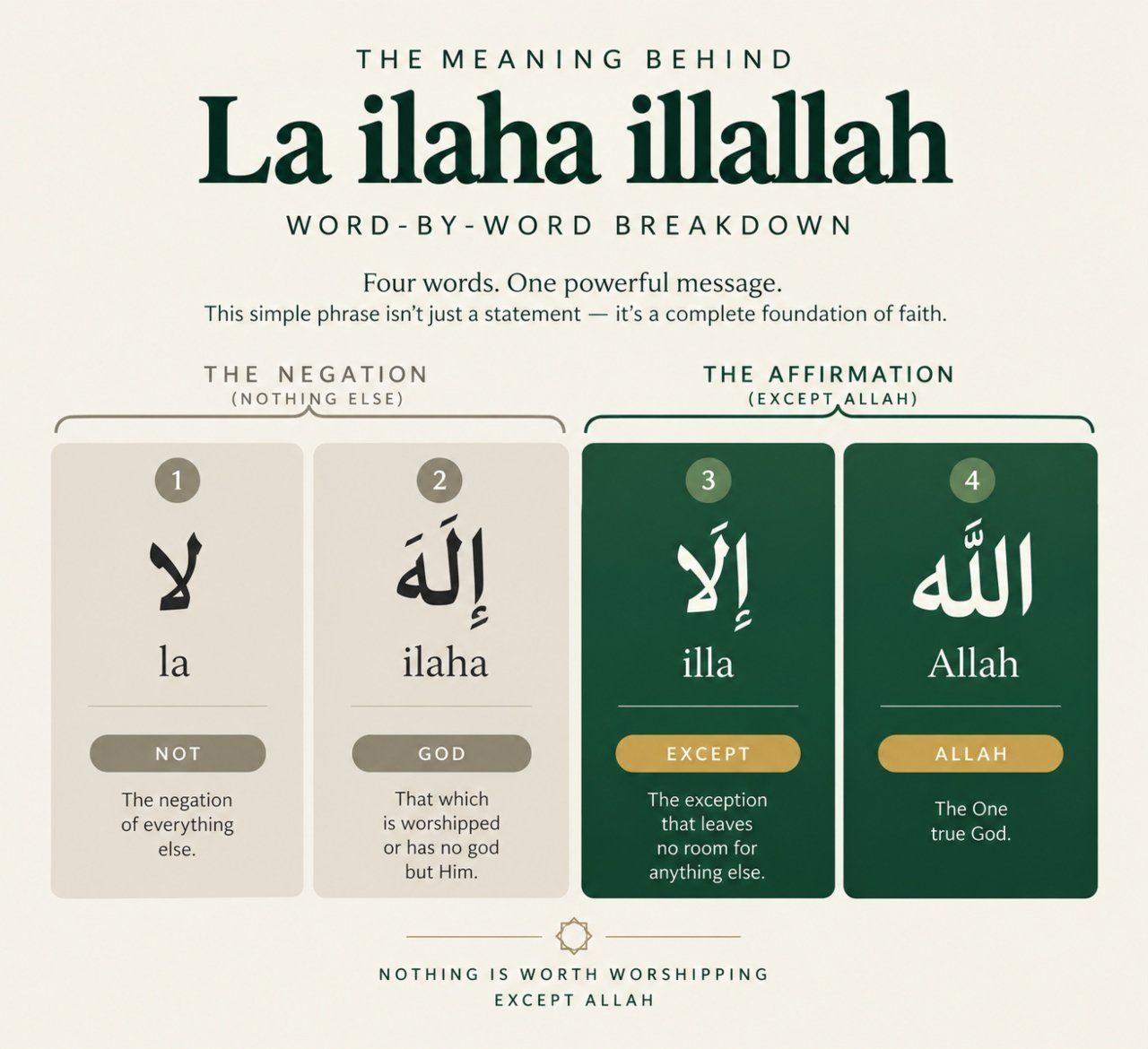
Look at the first half: la ilaha illallah.
It does not start with “God exists” or “Allah is one.” It starts with la — “no.” A negation. A rejection. The phrase literally reads “There is no god…” and only then, after clearing the table of every false object of worship, does it arrive at the exception: “…except Allah.”
This structure is not decorative. It is the entire theological point.
The Quran commands this directly: “So know that there is no deity except Allah” (Surah Muhammad, 47:19). The negation comes first because you cannot affirm the one true God while quietly keeping your other gods on the shelf. Those “gods” don’t have to be carved idols. They can be money, reputation, your own desires, tribal loyalty, political ideology — anything you organize your life around as though it were ultimate.
La ilaha sweeps all of that away. Illallah puts the only rightful object of worship in its place.
Scholars of tawhid (the oneness of God) call this structure nafy wa ithbat — negation and affirmation. You reject, then you affirm. The order is non-negotiable. Affirmation without negation is incomplete. You can say “Allah is God” while still bowing to other things in practice. The la ilaha half is what turns the Shahada into a revolution in a person’s life rather than a sentence they memorize and forget.
Two halves, one declaration
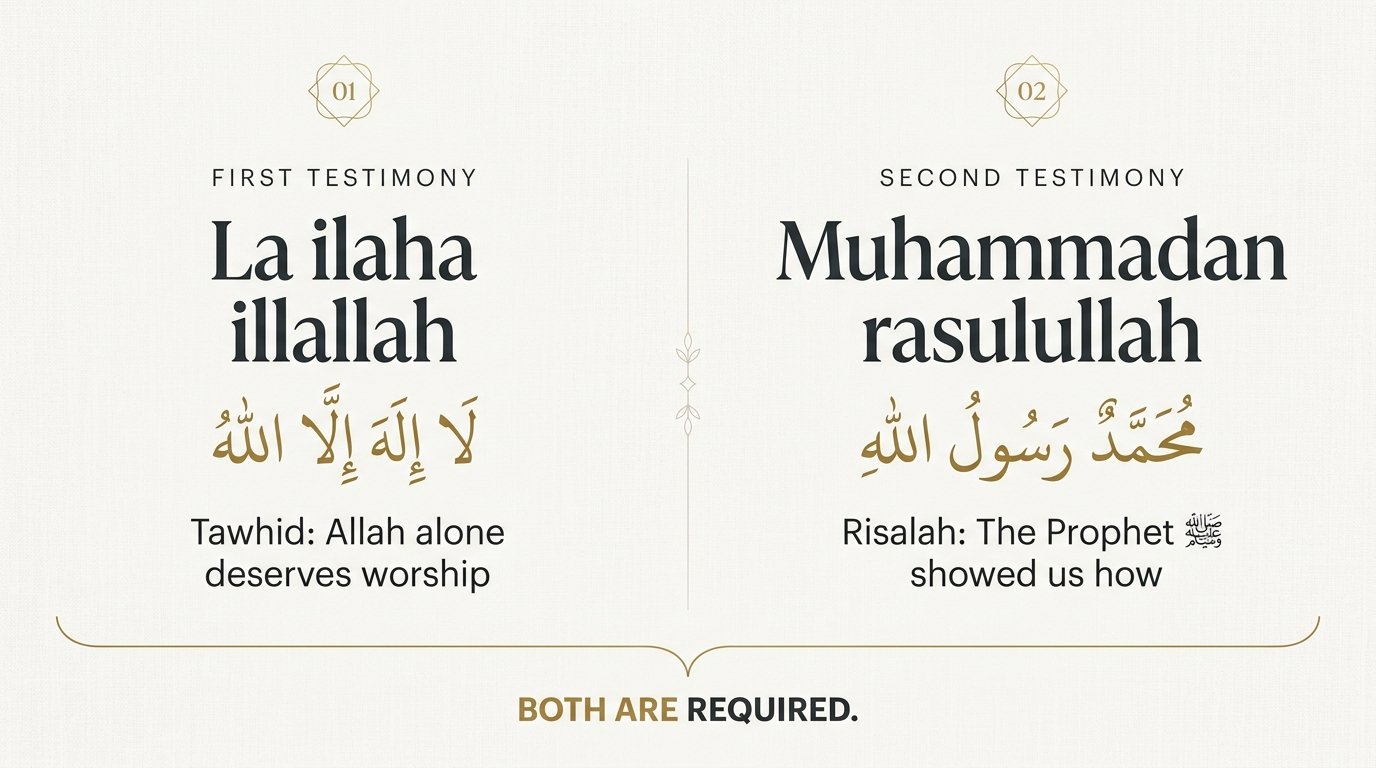
The full Shahada contains two testimonies, and both are required.
The first — la ilaha illallah — establishes tawhid. It declares that Allah alone deserves worship.
The second — Muhammadan rasulullah — establishes that Muhammad ﷺ is the Messenger of Allah. This is not a biographical footnote tacked onto the first half. It answers a practical question the first half leaves wide open: if I’m supposed to worship Allah alone, how? What does that worship actually look like? Through what guidance?
The Prophet Muhammad ﷺ is the one who showed humanity how to live out la ilaha illallah in concrete terms — how to pray, how to give charity, how to fast, how to treat neighbors, how to conduct business, how to govern. Without the second testimony, the first remains an abstract idea. You’ve declared the destination but refused the map.
This is why the Quran links obedience to the Messenger directly with obedience to Allah: “He who obeys the Messenger has obeyed Allah” (Surah An-Nisa, 4:80). The two halves of the Shahada are inseparable in Islamic theology. One without the other is incomplete.
Saying it is not the same as fulfilling it
Here is where most beginner resources stop, and where the real conversation should start.
Pronouncing the Shahada with your tongue is the minimum threshold. It makes you a Muslim in the eyes of the community, and that matters — no one should gatekeep your entry into the faith. But classical Islamic scholarship has long held that the Shahada carries conditions that go deeper than pronunciation. These conditions are derived from various Quranic verses and hadith, and scholars traditionally list seven:
Knowledge (‘ilm). You need to understand what the words mean. Reciting a phrase in a language you don’t comprehend, without any effort to learn its meaning, misses the point. The Quran says “So know that there is no deity except Allah” (47:19) — the command to know precedes the declaration itself.
Certainty (yaqin). The opposite of doubt. This doesn’t mean you’ll never experience a moment of spiritual confusion — human beings are not angels. It means your foundational conviction is firm. You’re not hedging your bets.
Sincerity (ikhlas). You say it for Allah alone, not to please your spouse, fit into a community, or gain social advantage. The Quran is blunt about this: “And they were not commanded except to worship Allah, being sincere to Him in religion” (Surah Al-Bayyinah, 98:5).
Truthfulness (sidq).
Your heart matches your tongue. The Prophet ﷺ warned against those who say the words while their hearts are elsewhere.
Love (mahabbah). You love what the Shahada demands of you — love for Allah, love for His Messenger, love for what they command. Not a vague sentimentality, but a love that shows up in choices.
Submission (inqiyad). You act on it. The Shahada is not a belief you store in your mind; it’s a commitment that restructures your behavior.
Acceptance (qabul). You accept all of what the Shahada entails, not just the parts that are convenient. You don’t cherry-pick.
Does a new Muslim need to have all seven perfected on day one? No. That’s a lifetime project. But these are the directions you’re facing when you say the words. They give the Shahada its weight and keep it from becoming an empty ritual.
When and how it is recited
The Shahada is not a one-time ceremony you complete and file away. It’s woven into the daily fabric of a Muslim’s life in ways that surprise people who assume it’s only relevant at conversion.
At the moment of entering Islam. A person who wishes to become Muslim recites the full Shahada aloud, ideally in front of witnesses, with understanding and sincerity. There is no elaborate ritual required. No priest, no baptism, no waiting period. The declaration itself, spoken with conviction, is the act of conversion. [YOUR EXAMPLE: if you’ve witnessed or guided someone through taking the Shahada, a brief note on what that moment felt like would be powerful here]
In every call to prayer (adhan). The muezzin’s call that rings out from mosques five times a day contains the Shahada twice — the two testimonies are recited in sequence as part of the adhan’s structure. If you live near a mosque, you hear the Shahada more often than you might realize.
In every unit of prayer (salah).
During the tashahhud — the seated portion of the prayer — Muslims recite the Shahada. Since the minimum daily prayers total 17 rak’ahs (units), a practicing Muslim says the Shahada at least 17 times a day in obligatory prayer alone, and more if they pray the voluntary sunnah prayers.
As dhikr (remembrance). The phrase la ilaha illallah is considered the highest form of dhikr. The Prophet ﷺ said, “The best remembrance is la ilaha illallah” (Jami` at-Tirmidhi, 3383). Many Muslims repeat it throughout the day — while commuting, while working, while falling asleep — as a way of re-centering their attention on what matters.
At the end of life. Muslims are encouraged to gently prompt a dying person to say la ilaha illallah as their final words. Hadith literature holds that whoever’s last words are la ilaha illallah will enter Paradise (Sunan Abi Dawud, 3116). [FLAG: verify exact wording and grading of this narration before publishing — the concept is well-established across collections but the specific reference varies.]
What the Shahada is not
A few misunderstandings come up often enough to address directly.
It is not a magic formula. Saying the words while living in deliberate, unrepentant opposition to everything they stand for is not what the Quran or the Prophet ﷺ described as faith. The Kharijites of early Islamic history made the opposite error — declaring anyone who committed a major sin a non-Muslim — and mainstream scholarship rejected that extremism too. The Shahada is the foundation, and what you build on it matters enormously.
It is not limited to Muslims by birth. Anyone can take the Shahada at any age, from any background. There is no ethnic or racial prerequisite. The universality of the declaration is one of its defining features.
It is not a private matter in the way modern individualism frames “personal belief.” The Shahada has social and communal dimensions. It places you in a relationship with the global Muslim community (the ummah), and it carries obligations toward other people — justice, charity, honesty — not just private devotion.
Where to go from here
If you’re reading this because you’re considering taking the Shahada, the most practical next step is to find a local mosque or a trusted Islamic teacher who can walk you through it in person. The act itself takes less than a minute. The learning that surrounds it takes a lifetime, and you don’t need to have it all figured out before you begin.
If you’re already Muslim and the Shahada has started to feel like background noise — something you repeat on autopilot during prayer — try slowing down the next time you reach the tashahhud. Say la ilaha illallah as though you are actively rejecting every false god in your life and actively choosing Allah. The grammar hasn’t changed in 1,400 years. The negation still comes first. The revolution is still available.
CLAIMS & SOURCES TO VERIFY
- Surah Muhammad 47:19 — “So know that there is no deity except Allah.” Verified; standard translation.
- Surah An-Nisa 4:80 — “He who obeys the Messenger has obeyed Allah.” Verified; standard translation.
- Surah Al-Bayyinah 98:5 — “And they were not commanded except to worship Allah, being sincere to Him in religion.” Verified.
- Surah Al-Imran 3:18 — Referenced in competitor analysis as a tawhid verse; not quoted directly in the article but available if you want to add it.
- Hadith of the Five Pillars (Bukhari 8, Muslim 16) — The foundational hadith of Ibn Umar. Not quoted verbatim but underpins the “first pillar” claim. Verified.
- “The best remembrance is la ilaha illallah” — Jami` at-Tirmidhi 3383. Verified; graded hasan by al-Tirmidhi.
- Last words hadith (Sunan Abi Dawud 3116) — The concept is well-established across multiple collections (Abu Dawud, al-Hakim, etc.), but the exact numbering and grading vary. Please verify the specific reference number and grading with your scholar/editor before publishing.
- The seven conditions of the Shahada — This is a classical scholarly framework (commonly attributed to scholars like Ibn al-Qayyim and later systematized by Muhammad ibn Abd al-Wahhab and others). It is not a single hadith listing all seven. The article attributes it to “classical Islamic scholarship” and “scholars,” which is accurate.
FAQs
What does la ilaha illallah mean word for word?
La = no / not. Ilaha = god / deity / anything worshipped. Illa = except. Allah = Allah (the proper name of God in Arabic). So the literal, word-by-word reading is: “No god except Allah.” The grammar matters because the negation (la ilaha) comes first — you clear out every false object of worship before you affirm the real one. It’s a rejection followed by a declaration, not just a statement of monotheism.
Can I say the Shahada by myself to become Muslim?
Yes. The Shahada is valid between you and Allah even if no one else hears it. Witnesses are strongly recommended — they establish your conversion in the community so you can access things like a Muslim burial, marriage, and communal support — but they are not a theological requirement for the declaration to count. If you’re in a situation where no Muslim is available and you feel ready, say it with understanding and sincerity. Then find a mosque or community as soon as you can to make it known.
Do I have to say the Shahada in Arabic?
For the act of conversion itself, scholars differ slightly, but the majority position is that saying it in a language you genuinely understand fulfills the obligation if you cannot yet pronounce the Arabic. The meaning is what carries the weight, not the phonetics. That said, learning the Arabic is a short-term goal you should start on immediately — it takes most people a few days of practice — because you’ll need it for daily prayer, which does require Arabic recitation.
Is the Shahada in the Quran?
The exact formula as a single combined sentence (“I bear witness that there is no god but Allah and that Muhammad is the Messenger of Allah”) does not appear verbatim in one verse. But both halves are thoroughly Quranic. La ilaha illallah echoes through dozens of verses, most directly in Surah Muhammad 47:19: “So know that there is no deity except Allah.” The testimony about the Prophet ﷺ appears in Surah Al-Fath 48:29 and Surah Al-Imran 3:18, where Allah and the angels bear witness alongside “those of knowledge.” The Shahada as a combined declaration is drawn from the Quran and the Sunnah together.
What is the difference between the Shahada and the Kalima?
In everyday usage, especially in South Asian Muslim communities, “Kalima” (from the Arabic kalimah, meaning “word” or “statement”) often refers specifically to la ilaha illallah Muhammadur rasulullah — which is the same content as the Shahada. The difference is mostly contextual. “Shahada” emphasizes the act of bearing witness (the word comes from the Arabic root sh-h-d, to witness). “Kalima” emphasizes the statement itself. In practice, when someone says “the first Kalima,” they mean the Shahada. The terms overlap heavily and the distinction is more linguistic than theological.
What should I do right after taking the Shahada?
Three things, in roughly this order. First, perform ghusl (a full ritual bath) — the Prophet ﷺ instructed new converts to do this, and it marks a clean spiritual start. Second, begin learning the basics of salah (prayer), because your first prayer time will arrive within hours and you’ll want to participate even if imperfectly. Third, connect with a local mosque or a knowledgeable Muslim who can guide your next steps — wudu, the prayer movements, the short surahs you’ll need. Don’t try to learn everything at once. The Shahada is the door. You walk through it one step at a time.