If you are asking “what is Islam religion?”, the simplest answer is this: Islam is a monotheistic religion centered on worshipping one God, known in Arabic as Allah, and living according to His guidance. Muslims believe that this guidance was conveyed through prophets and revealed scriptures, with the Qur’an as the final revelation given to Prophet Muhammad.
But that answer only gets you through the front door.
To understand Islam properly, it helps to see how its major ideas connect: God, revelation, prophets, the Qur’an, faith, worship, morality, and life after death.
What does Islam mean?
The word Islam is an Arabic term associated with submission and surrender to God. IslamQA explains the religious meaning in terms of submitting to Allah, worshipping Him alone, obeying His commands, and believing what He has revealed.
The Qur’an itself identifies Islam by name:
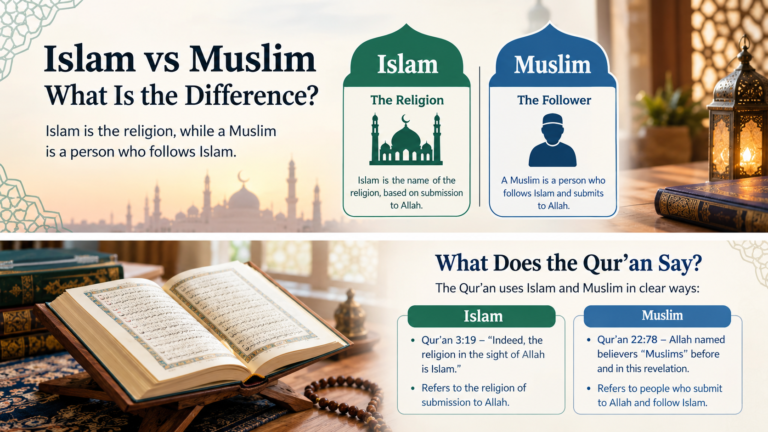
“Indeed, the religion in the sight of Allah is Islam.” — Qur’an 3:19
This is also where an important distinction comes in.
Islam is the religion. A Muslim is a person who follows Islam.
The two words are related, but they are not interchangeable. A person is called a Muslim because of their relationship to Islam. IslamQA makes this distinction explicitly when explaining the terms.
Is Islam a religion?
Yes. Islam is a religion, but Muslims also understand it as a way of life shaped by belief in God and obedience to His guidance.
That distinction matters because Islam is not presented in the Qur’an as something limited to a weekly religious service or a private set of beliefs. Worship, prayer, charity, fasting, family relationships, honesty, contracts, personal conduct, and responsibility toward other people all have a place within Islamic teaching.
The Qur’an describes righteousness through both belief and action. Qur’an 2:177 mentions belief in Allah, the Last Day, angels, revealed Books and prophets, while also describing charity, prayer, keeping promises and patience.
So if someone asks, “What is Islam all about?”, the answer cannot stop at theology.
Islam connects what a person believes with how that person lives.
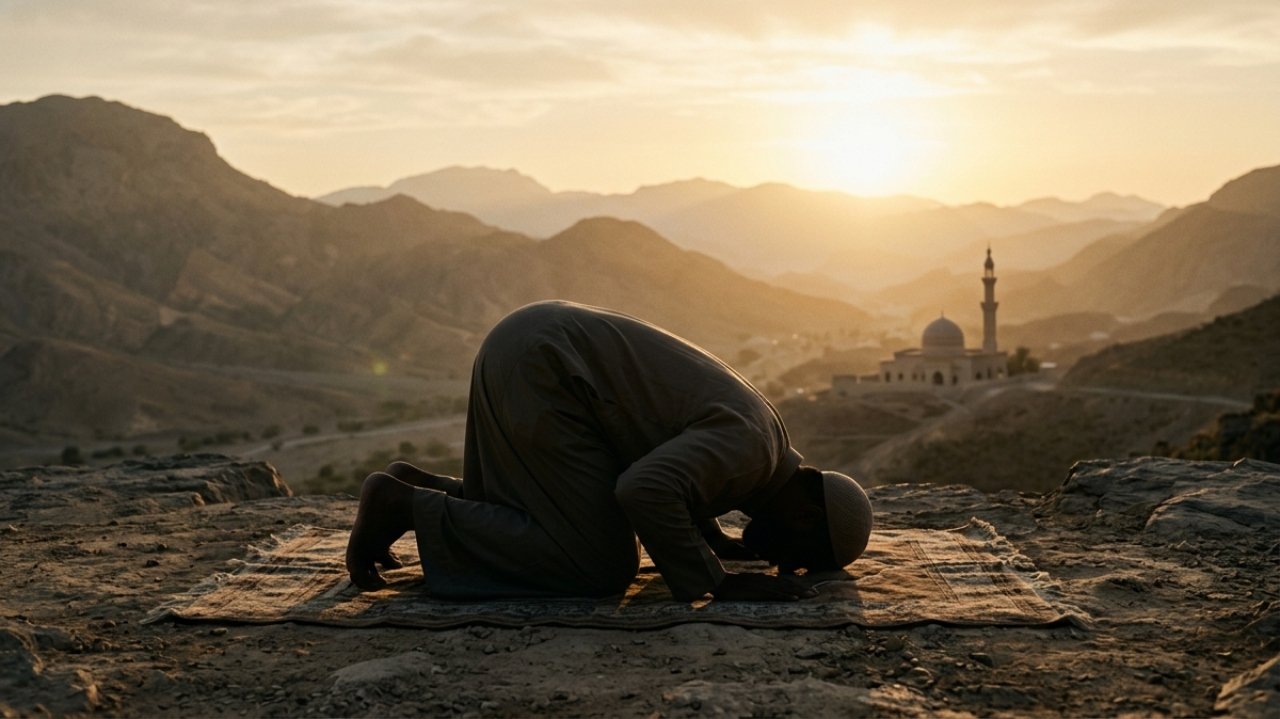
Who is Allah in Islam?
Allah is the Arabic name for God.
Muslims believe that Allah is one and has no partner in worship. The Qur’an expresses this idea especially clearly in Surah Al-Ikhlas:
“He is Allah—One.” — Qur’an 112:1
The same short chapter continues by describing Allah as the Sustainer and stating that He neither has offspring nor was He born, and that nothing is comparable to Him.
This belief in the absolute oneness of God is called tawhid.
It is the foundation underneath the rest of Islamic belief.
A Muslim does not worship Muhammad, angels, saints, natural forces, or any created thing. Worship belongs to Allah alone.
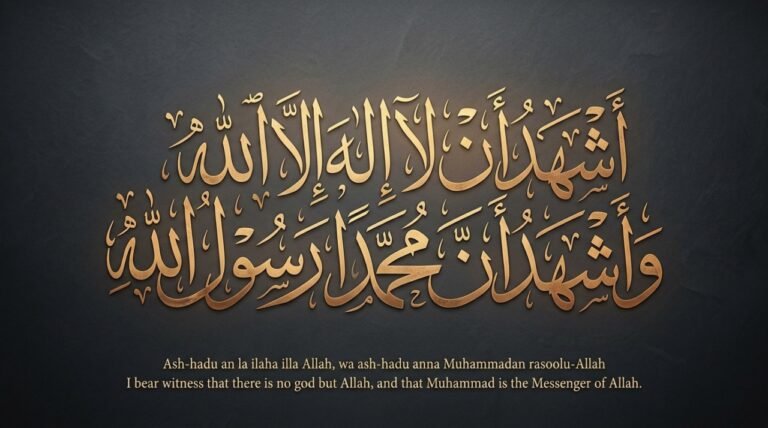
This is why the first part of the Shahada, the Islamic testimony of faith, declares that there is no deity worthy of worship except Allah.
Who is Prophet Muhammad?
Prophet Muhammad is the central human messenger of Islam.
Muslims believe that Muhammad was a prophet and messenger of God and that the Qur’an was revealed to him. Yaqeen’s introduction describes Muhammad as the final prophet and messenger in the Islamic understanding.
Muslims do not worship Muhammad.
Instead, they believe that he delivered God’s revelation and provided an example of how that revelation should be lived.
His teachings and practices are known as the Sunnah.
This gives Islam a structure that is easy to understand:
God is the source of revelation.
The Qur’an is the central revealed scripture.
Muhammad conveyed the revelation and demonstrated its application.
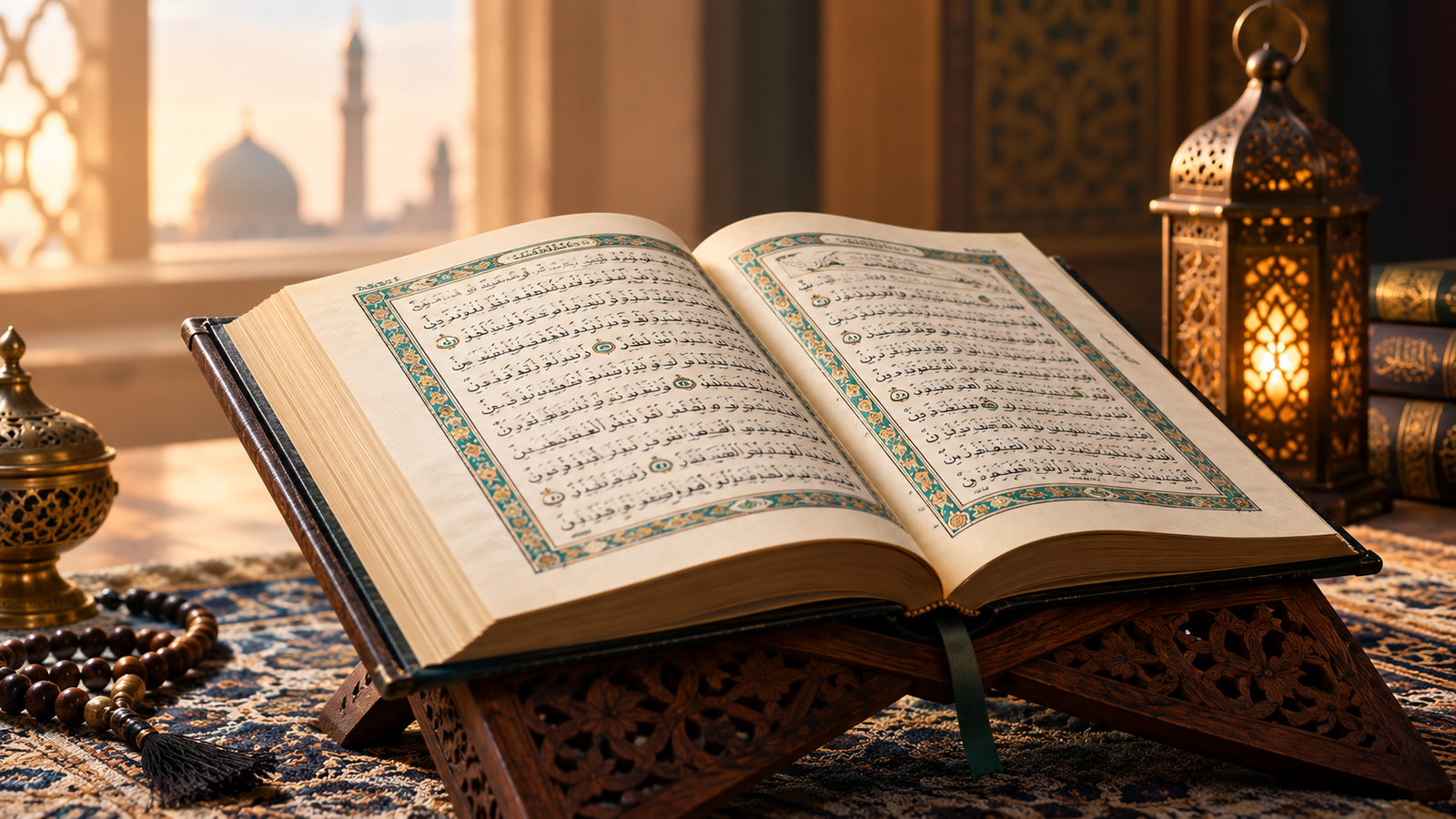
What is the Qur’an?
The Qur’an is the central scripture of Islam.
Muslims believe it is the revelation from Allah given to Prophet Muhammad through the Angel Jibril (Gabriel). Yaqeen’s basic introduction describes the Qur’an as God’s final revealed message and states that its revelation to Muhammad occurred over 23 years.
For someone beginning to study Islam, this point is worth taking seriously: the Qur’an is not simply a historical book about Muslims.
It is the primary religious text through which Muslims understand God’s guidance.
The Qur’an discusses God, human beings, prophets, worship, morality, family life, justice, accountability, death, resurrection and the life to come.
That is why learning what Islam teaches without looking at the Qur’an itself leaves an important piece missing.
What do Muslims believe?
Islamic belief is commonly summarized through six articles of faith.
They are belief in:
- Allah
- Angels
- Allah’s revealed Books
- Allah’s Messengers
- The Day of Judgment
- Divine Decree
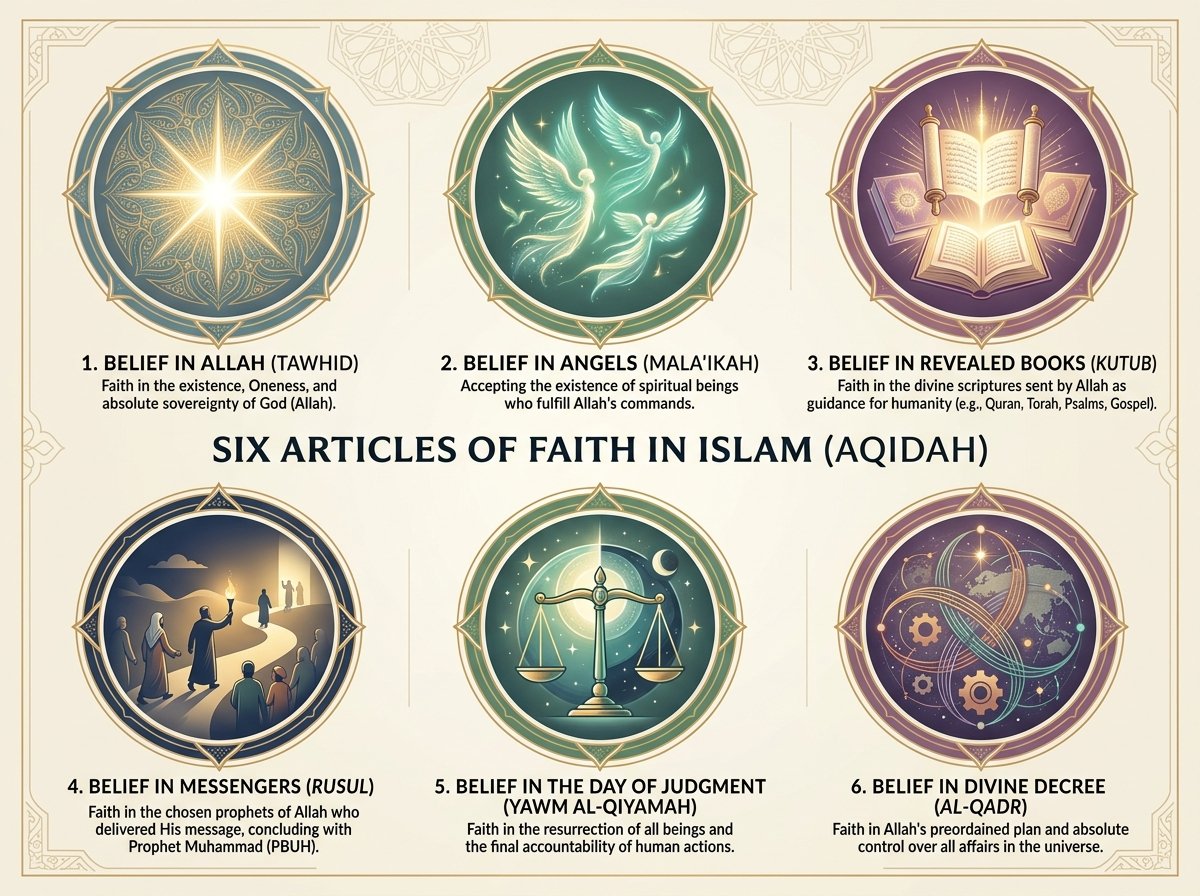
Yaqeen’s introductory material identifies these as the six core articles of Islamic faith.
The Qur’an also brings several of these beliefs together in Qur’an 2:177, mentioning belief in Allah, the Last Day, angels, Books and prophets.
These beliefs answer the big questions behind Islamic life.
Who created us? Allah.
How do we know what He wants from us? Through His revelation and messengers.
What happens after this life? Muslims believe in resurrection, judgment and the Hereafter.
How should we live now? Through faith, worship, moral conduct and obedience to God’s guidance.
That is the framework.
What are the Five Pillars of Islam?
The Five Pillars of Islam describe five foundational practices of Muslim religious life:
- Shahada — testimony of faith
- Salah — prayer
- Zakat — obligatory charity
- Sawm — fasting during Ramadan
- Hajj — pilgrimage to Makkah for those able to perform it
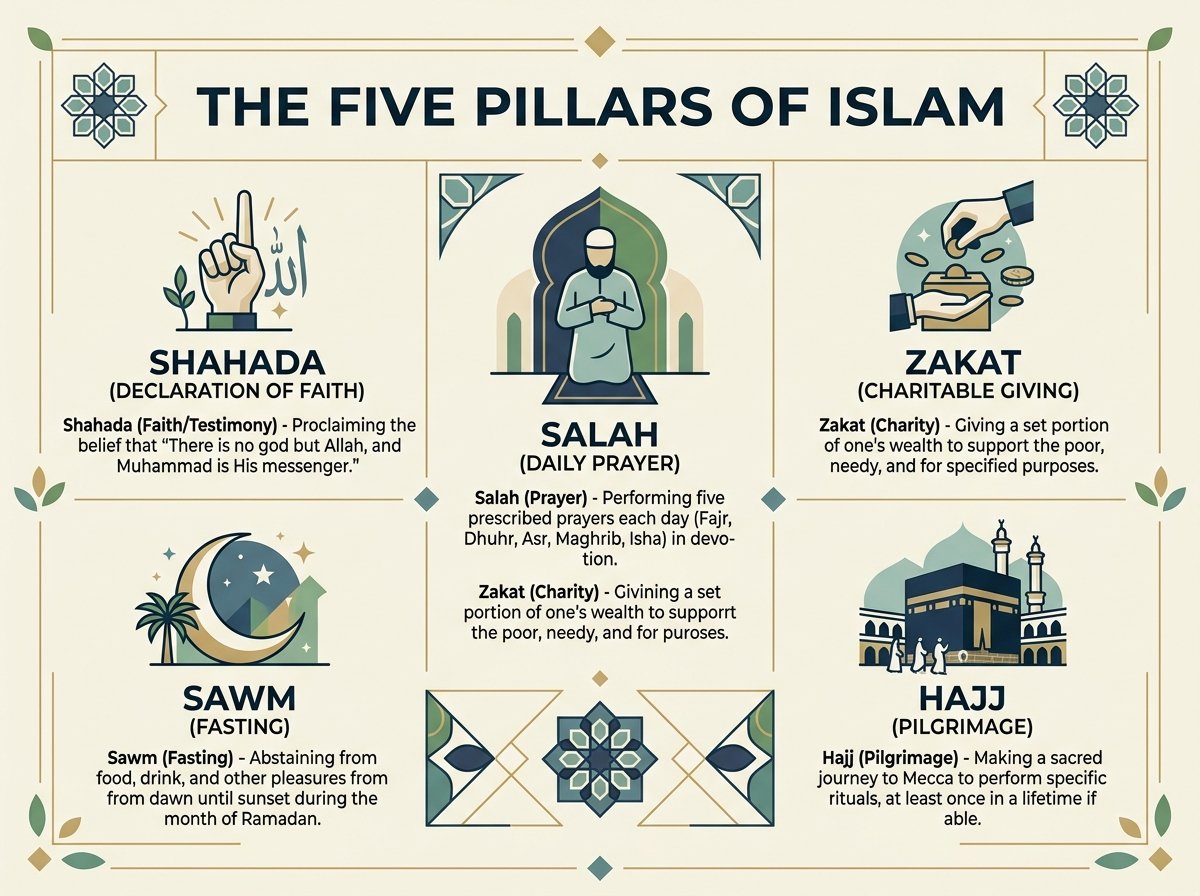
Yaqeen’s current introduction lists these five practices as the foundational pillars of Islam.
The first pillar is the Shahada, the testimony that there is no deity worthy of worship except Allah and that Muhammad is His messenger.
The second is Salah, the five daily prayers.
The third is Zakat, an obligatory form of charity for those who meet its conditions.
The fourth is Sawm, fasting during Ramadan.
The fifth is Hajj, the pilgrimage to the Ka’bah in Makkah for those who are able.
These practices give Islamic belief a visible shape.
Faith is not treated as something that exists only in the mind.
Why do Muslims pray?
Prayer is one of the most recognizable practices of Islam because Muslims are required to perform five daily prayers at prescribed times.
The purpose is not simply to repeat words or movements.
Prayer is an act of worship directed toward Allah and a regular reminder of the relationship between the worshipper and the Creator. Yaqeen describes the daily prayers as a foundational part of fulfilling the Islamic understanding of humanity’s purpose.
This is one reason the daily rhythm of Islamic life looks different from a purely intellectual belief system.
A Muslim’s day has recurring moments of worship built into it.
Why do Muslims fast during Ramadan?
During Ramadan, Muslims fast from dawn until sunset.
Fasting is called sawm and is one of the Five Pillars of Islam.
But fasting is not simply about avoiding food and drink.
It is an act of worship and self-discipline. Ramadan also becomes a period in which Muslims give greater attention to prayer, Qur’an recitation, charity, repentance and spiritual reflection.
What is Zakat?
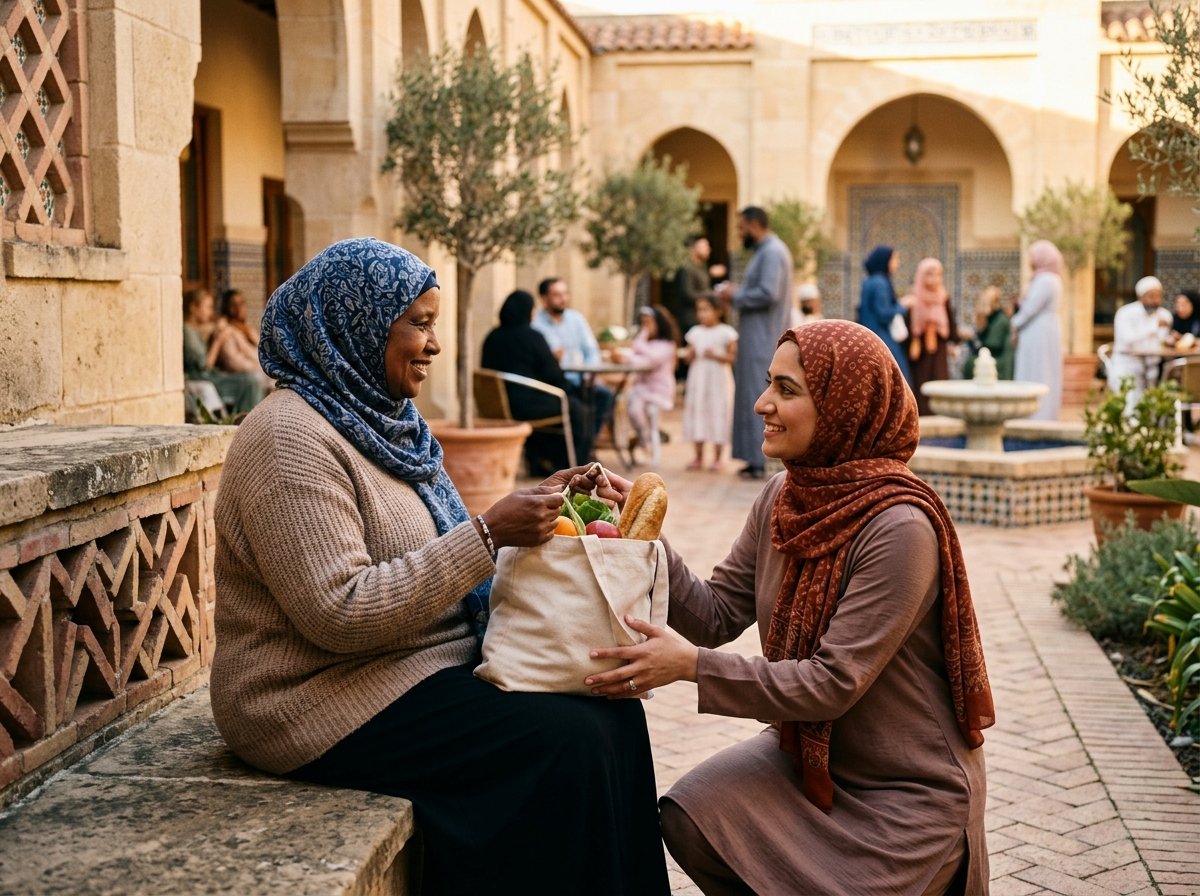
Zakat is an obligatory form of charity in Islam that applies to Muslims who meet the relevant conditions.
It is one of the Five Pillars.
The principle connects worship with social responsibility. Qur’an 2:177, for example, links faith with giving wealth to relatives, orphans, people in need and travelers, alongside prayer and other acts of righteousness.
It is a useful reminder that Islamic worship is not limited to what happens inside a mosque.
How someone treats other people matters too.
What is Hajj?
Hajj is the pilgrimage to the Ka’bah in Makkah.
It is one of the Five Pillars of Islam and is required of Muslims who are able to undertake it.
Hajj brings together Muslims from different countries and backgrounds in one major act of worship.
It also connects modern Muslim practice with the religious history surrounding Ibrahim (Abraham), his family, and the sacred sites of Makkah.
What is the Shahada?
The Shahada is the testimony of Islamic faith.
Its central meaning is that there is no deity worthy of worship except Allah and that Muhammad is the Messenger of Allah.
It is not merely a slogan.
It summarizes two foundational commitments: worshipping Allah alone and accepting Muhammad as God’s messenger.
Yaqeen describes the Shahada as encapsulating the religion’s central declaration of monotheism and acceptance of Muhammad as the final prophet and messenger.
What does Islam say about other prophets?
Islam does not begin its prophetic story with Muhammad.
Muslims believe in a long line of prophets and messengers, including Adam, Noah, Ibrahim, Musa (Moses), Isa (Jesus) and Muhammad.
The exact theological understanding of each prophet is important, but the basic point is straightforward: Muslims believe God sent messengers to guide humanity.
Islam therefore sees Muhammad’s message in continuity with earlier prophetic revelation.
Yaqeen describes Islam as affirming a prophetic tradition that includes figures such as Adam, Abraham, Moses and Jesus, while identifying Muhammad as the final prophet.
What do Muslims believe about Jesus?
Jesus, known as Isa in Arabic, holds an important place in Islam.
Muslims believe that Jesus was a prophet and messenger of God and that he was born miraculously to Maryam (Mary). Yaqeen’s Islamic introduction describes Jesus as the Messiah and explains his special position among the prophets.
At the same time, Islamic theology does not identify Jesus as God.
This is one of the major differences between Islamic and mainstream Christian theology.
What is the purpose of life in Islam?
Islam gives human existence a religious purpose: worshipping Allah.
The Qur’an states:
“And I did not create the jinn and mankind except to worship Me.” — Qur’an 51:56
Worship in Islam is broader than prayer alone.
The Islamic concept of worship includes acts specifically performed for Allah as well as living according to His guidance.
That changes the way the religion approaches ordinary life.
Work, family responsibilities, generosity, honesty, keeping promises and avoiding wrongdoing can all be connected to a person’s religious responsibility.
The point is not to separate “religious life” from “real life.”
Islam addresses both.
What happens after death according to Islam?
Muslims believe that earthly life is followed by resurrection, judgment and the Hereafter.
Belief in the Last Day is one of the six articles of faith.
That belief changes the meaning of everyday choices.
A person’s actions are not considered meaningless or forgotten. Islamic teaching connects human responsibility with accountability before Allah.
The Qur’an’s description of righteousness in 2:177 combines belief, worship, generosity, fulfilling commitments and patience, showing how Islamic faith connects inward belief with outward conduct.
Is Islam only about rituals?
No.
Ritual worship is central, but the Islamic picture is wider.
A useful way to understand it is to think in layers:
Belief answers what Muslims believe about God, revelation and the unseen.
Worship describes practices such as prayer, fasting, zakat and Hajj.
Character concerns honesty, patience, mercy, justice and responsibility.
Relationships cover family, neighbors, communities and wider society.
Accountability gives these choices an ultimate religious context through belief in the Hereafter.
This is one of the points that gets lost when Islam is reduced to a list of rules.
The list matters. But the list is not the whole religion.
Is Islam the same as being Muslim?
No.
This is a simple distinction, but it causes confusion for beginners.
Islam is the religion.
Muslim refers to a person who follows or submits to God according to Islam.
IslamQA specifically addresses this distinction and explains why the person is called a Muslim while the religion is called Islam.
Why do Muslims call God “Allah”?
“Allah” is the Arabic word Muslims use for God.
It is not the name of a different deity invented for Muslims. Arabic-speaking Christians also use “Allah” when referring to God.
The Islamic understanding of God is defined by absolute monotheism: Allah is one and has no partner.
Surah Al-Ikhlas gives a compact Qur’anic description of this belief.
What makes Islam different from a philosophy?
A philosophy can offer ideas about life, ethics or knowledge.
Islam makes a stronger religious claim: God has revealed guidance to humanity through prophets and scripture.
That means Islamic belief is not based only on a person’s private search for meaning.
It rests on revelation, worship and a relationship between the Creator and the human being.
For Muslims, the Qur’an and the teachings and example of Prophet Muhammad are therefore central sources for understanding what Islam requires.
How should a beginner start learning about Islam?
Don’t start with the most controversial question you can find online.
Start with the foundations.
Read about:
- Who Allah is.
- What Muslims believe.
- Who Muhammad was.
- What the Qur’an teaches.
- The Five Pillars.
- The Six Articles of Faith.
- How Islamic worship works.
- How Islam understands morality and accountability.
Then read the Qur’an itself with a reliable translation and explanatory resources.
And when a question involves a detailed legal ruling, don’t assume that a random social-media post represents Islam as a whole. Check the underlying Qur’anic or hadith evidence and, where appropriate, consult a qualified scholar.
Frequently Asked Questions
Is Islam a religion?
Yes. Islam is a monotheistic religion centered on worshipping Allah and following His revealed guidance. The Qur’an explicitly identifies Islam as a religion in Qur’an 3:19.
What does Islam mean?
Islam is an Arabic term associated with submission and surrender to God. In Islamic religious usage, it refers to submitting to Allah, worshipping Him alone and following His guidance.
What do Muslims believe?
Muslims believe in Allah, His angels, His revealed Books, His messengers, the Day of Judgment and Divine Decree. These are commonly called the Six Articles of Faith.
What are the Five Pillars of Islam?
The Five Pillars are Shahada, Salah, Zakat, Sawm during Ramadan and Hajj for those who are able to perform it.
Who do Muslims worship?
Muslims worship Allah alone. Islamic monotheism rejects associating partners with God. Surah Al-Ikhlas presents Allah as One and incomparable.
Do Muslims believe in Jesus?
Yes. Muslims believe Jesus, or Isa, was a prophet and messenger of God and was born miraculously to Mary. Muslims do not believe that Jesus is God.
What is the difference between Islam and Muslim?
Islam is the name of the religion. A Muslim is a person who follows Islam. The terms are related but do not mean the same thing.
What is the Qur’an?
The Qur’an is the central revealed scripture of Islam. Muslims believe it was revealed by Allah to Prophet Muhammad through the Angel Gabriel and represents God’s final revelation.
The simplest way to understand Islam
If you remember only one framework from this article, use this:
Allah is the one God.
The prophets conveyed His guidance.
The Qur’an is the central revealed scripture of Islam.
Muhammad is believed to be the final prophet and messenger.
Muslims express their faith through belief, worship and conduct.
The Five Pillars provide a foundation for religious practice.
The Six Articles of Faith summarize essential beliefs.
Life is understood as purposeful and accountable before God.
That is a much better starting point than memorizing isolated facts.
If you’re beginning to study Islam, the next step should be to go from the overview to the primary sources: learn the basic beliefs, read the Qur’an with a reliable translation, study the life and teachings of Prophet Muhammad, and then explore individual practices such as Salah, fasting, Zakat and Hajj.